Zillow Shows Listings… Not Pressure
Most people searching for how to find distressed properties on Zillow assume distress means foreclosures, boarded windows, or listings screaming for attention. That assumption is exactly why they miss opportunities. Real distress rarely looks dramatic, and it almost never announces itself clearly.
The bigger issue is how distress is defined. Buyers and agents tend to focus on property condition instead of seller pressure. A house can look fine while the seller is running out of time. Another can need work but belong to someone in no hurry at all. Zillow does not help you make that distinction.
Zillow is best understood as one tool inside a broader system. It shows you where friction exists, not why it exists. This is the same reason experienced investors rely on layered systems and real estate investing tools rather than treating any single platform as complete. Zillow surfaces signals. The leverage comes from knowing how to interpret them.
This article is about shifting how you read listings.
You will learn how to spot distress early, before it becomes obvious. You will see why agents often overlook these properties, even when they are publicly listed. And you will learn how to read Zillow listings differently, focusing on behavior instead of presentation.
If you can read seller behavior, Zillow becomes a lead source, not a browsing app.
What “Distressed” Really Means on Zillow

Distress on Zillow almost never shows up early, and that is the first assumption that needs to be reset. By the time a listing is clearly labeled as distressed, most of the leverage has already evaporated. Zillow does not surface early pressure. It reflects what sellers and agents are willing to broadcast.
Understanding this difference changes how you read every listing that follows.
Why Zillow Almost Never Shows Early Stage Distress
Zillow rarely shows early stage distress because the platform is built on public facing listing data, not private seller realities. Early distress is messy, personal, and often unspoken. None of that translates cleanly into a listing feed.
Sellers in the early phase are still trying to hold the line. They believe the market will respond. They are testing price, timing, or presentation. Zillow captures the listing, not the struggle behind it. That is why the most motivated sellers often look indistinguishable from everyone else at first.
This delay is not a flaw. It is the opportunity.
Property Distress vs Seller Distress
Property distress and seller distress are not the same thing, but most buyers treat them as interchangeable. Property distress is visible. It shows up as outdated finishes, deferred maintenance, or poor photos. Seller distress is behavioral. It shows up in timelines, concessions, and fatigue.
A house can need work and still have an unmotivated seller. Another house can look perfectly fine while the seller is quietly running out of options. Zillow makes the first easy to see and the second easy to miss.
Deals are created by seller distress, not ugly houses.
Why Foreclosure and Pre Foreclosure Tags Are Late Signals
Foreclosure and pre foreclosure tags appear after months of financial damage have already occurred. By the time those labels show up, control has shifted away from the seller and toward the lender. Flexibility shrinks. Competition increases. Timelines compress.
These listings feel dramatic, which is why they attract attention. But drama is not the same thing as leverage. Early stage distress happens long before banks get involved, and Zillow does not flag that phase for you.
If you are waiting for labels, you are already late.
Why the Best Deals Often Look Normal at First Glance
The strongest opportunities on Zillow usually look ordinary. Clean photos. Generic descriptions. No obvious warning signs. They sit while attention drifts elsewhere.
What changes is not the appearance but the behavior. Days on market stretch. Language softens. Price adjustments stack. Momentum fades. To most people, these listings disappear into the background. To someone watching patterns, they quietly light up.
This is the core shift in learning how to find distressed properties on Zillow. You stop hunting for damage and start tracking pressure.
Most Zillow distress is invisible unless you know what to look for.
The 5 Zillow Signals That Quietly Indicate Distress
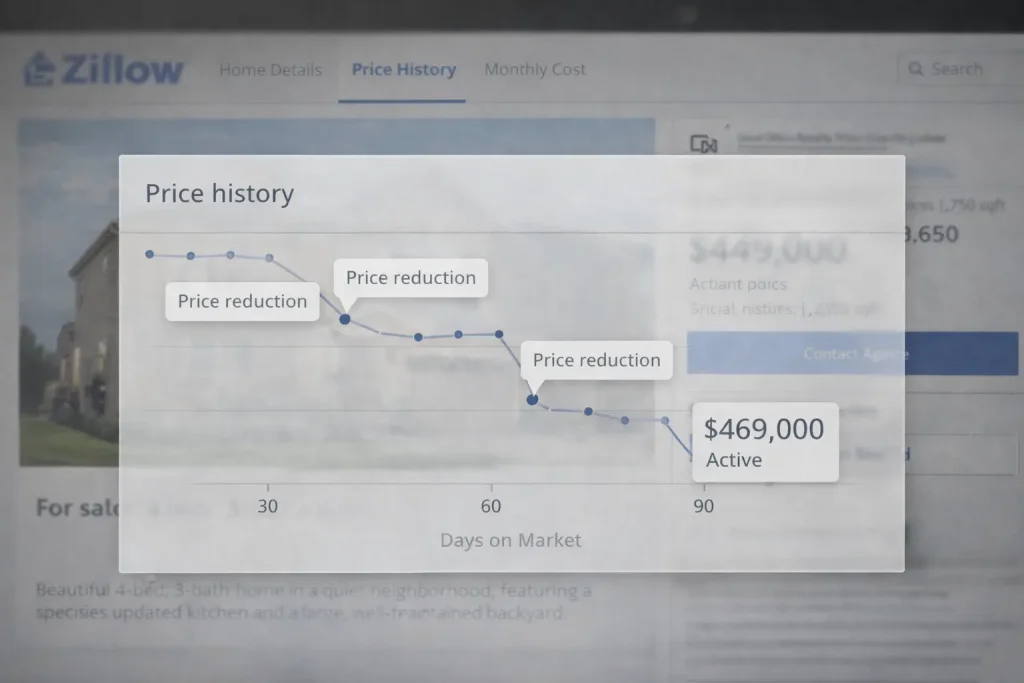
Distress on Zillow does not announce itself. It leaks out slowly through patterns most people are not watching for. These signals are subtle on their own, but when they stack, they tell a very different story than the listing headline suggests.
This is where pattern recognition matters more than filters.
Days on Market Creep Past 45 to 90 Days
Days on market is one of the earliest and most reliable indicators of pressure. Once a listing pushes past the typical rhythm of its local market, something has broken. Either pricing missed the mark, demand cooled, or the seller misjudged timing.
The important part is not the number itself. It is the change in posture that happens as days accumulate. Sellers become more flexible the longer a listing sits, even if nothing else visibly changes. Zillow shows you the clock, but it does not explain what that clock does to decision making.
Listings that quietly drift past 45, 60, or 90 days are often entering fatigue territory.
Multiple or Irregular Price Reductions
One price reduction means very little. Multiple reductions tell a story. Irregular cuts tell an even louder one. When prices drop inconsistently, it usually reflects internal disagreement or growing urgency behind the scenes.
Sellers who reduce once are still testing the market. Sellers who reduce repeatedly are reacting to it. Zillow tracks the history, but most people never open that tab. They just see the current price and move on.
Patterns in price changes reveal pressure long before desperation becomes obvious.
Outdated, Neglected, or Minimal Photos
Photos are effort. When listings show outdated photos, poor lighting, or minimal coverage, it often signals disengagement. Either the seller did not want to invest more money, or the listing has aged without improvement.
Early on, sellers refresh photos to regain attention. Later, they stop trying. Zillow keeps the same images even as motivation changes, which creates a mismatch between presentation and reality.
That mismatch is where opportunity hides.
Vacancy Clues Hidden in Plain Sight
Vacant homes behave differently. Empty rooms, missing appliances, lights off, or exterior neglect are small signals that the property is no longer being actively lived in. Vacancy increases carrying costs and shortens patience.
Zillow does not label vacancy clearly. You have to infer it. Once a property is no longer emotionally occupied, sellers tend to prioritize speed over pride.
Vacancy quietly accelerates fatigue.
As Is and Investor Friendly Language
Language shifts as pressure builds. Early listings focus on lifestyle and features. Later ones emphasize simplicity and flexibility. Phrases like as is, bring all offers, or investor friendly usually appear after resistance has worn down.
These words are not magic on their own. They matter when paired with time, price history, and presentation decay. Zillow shows the words, but it does not explain why they showed up when they did.
Language is often the last thing to change before a seller is ready to deal.
Agents miss these signals because they scan for marketability, not seller fatigue curves. They are trained to move forward, not watch something slowly unravel. Learning how to find distressed properties on Zillow means training yourself to notice what others are too busy to track.
How to Use Zillow Filters the Way Agents Don’t
Zillow filters are not the problem. The way most people use them is. Filters are typically treated as a one time setup instead of a system you revisit and refine as behavior changes. That is why they feel ineffective.
Used correctly, filters are not about finding deals today. They are about tracking pressure over time.
Why Most People Use Filters Once Instead of Over Time
Most buyers set their filters, scroll for a few minutes, and move on. They assume the results represent reality. What they are actually seeing is a snapshot, not a process.
Distress develops slowly. Filters are most powerful when you save searches, revisit them weekly, and notice what changes. A listing that keeps reappearing is more important than one that looks interesting once. Zillow gives you the ability to observe motion. Most users only look at still frames.
This is where agents and retail buyers think differently. Agents are trained to surface what is new. Investors should be watching what is stuck.
Time on Zillow and the Real Sweet Spot
Time on Zillow is useful only in context. The goal is not to find the oldest listing in town. The goal is to find listings that have crossed from optimism into fatigue.
In many markets, that transition starts somewhere between 45 and 90 days. Below that range, sellers are still anchored to their original expectations. Above it, flexibility increases quickly. Zillow lets you filter for time, but the real value comes from watching listings cross that threshold.
The moment a listing ages out of the normal market rhythm is when leverage begins to form.
Price Cuts and What Multiple Reductions Signal
Filtering for price cuts is a starting point, not a conclusion. One reduction is often strategic. Multiple reductions are reactive. When cuts stack, especially without a clear pattern, it usually reflects internal pressure rather than market calibration.
Zillow shows the price history clearly, but most users never click into it. They see the current number and assume that is the story. The history is where motivation shows up.
Repeated adjustments mean the seller is chasing demand instead of waiting for it.
Keyword Stacking Instead of Single Terms
Keywords are rarely meaningful on their own. The power comes from stacking them and watching how they appear together. Terms like as is, estate, handyman, or investor friendly often show up later in a listing’s life cycle.
Filtering for these words helps narrow the field, but the real insight comes from noticing when a listing adds them after sitting. That change usually reflects a shift in expectations, not a change in condition.
Language evolves as pressure builds.
What to Exclude to Reduce Noise
Knowing what to remove is just as important as knowing what to include. New construction should be excluded almost entirely. These sellers operate on schedules and margins, not urgency. Obvious flips should also be filtered out. They are priced for retail buyers and leave little room for negotiation.
By removing listings that are designed to sell quickly, you make it easier to see the ones that are quietly struggling.
Learning how to find distressed properties on Zillow is less about clever filters and more about disciplined observation. Filters do not find deals. Tracking behavior does.
Timeline
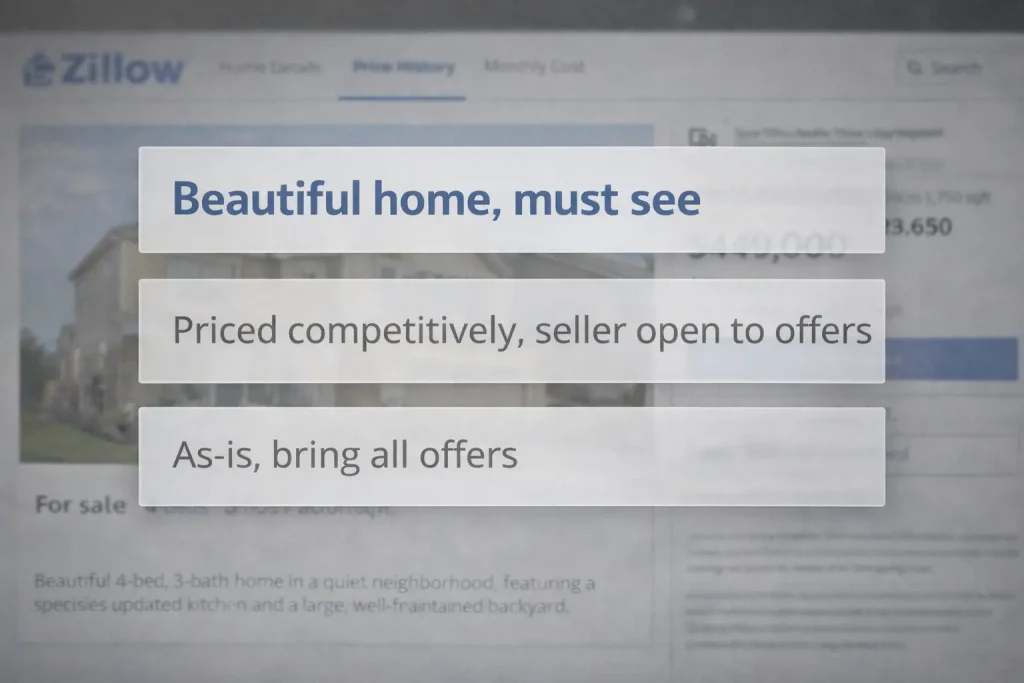
Listing language changes in predictable phases as pressure builds. If you read it as static marketing copy, it feels generic. If you read it as a timeline, it becomes psychological data.
Words lag reality. That lag is where leverage forms.
How Listing Language Changes as Pressure Increases
Early on, listings are written to impress. The language is aspirational, confident, and future focused. Sellers believe the market will meet them where they are. As time passes, that confidence erodes, and the wording starts doing different work.
Zillow preserves every revision, even though most readers only see the latest version. Subtle shifts in tone often matter more than the actual words. You are not reading what the home is. You are reading how the seller feels about waiting.
Pressure changes language before it changes price.
Early Stage vs Late Stage Phrases
Early stage listings lean heavily on lifestyle. Words like charming, perfect for, and must see dominate. These phrases assume optionality. The seller believes they can wait for the right buyer.
Late stage language becomes transactional. Terms like priced to sell, bring offers, or flexible closing appear. The focus moves away from identity and toward outcomes. The listing stops trying to persuade and starts trying to conclude.
The transition between these phases is more important than either phase itself.
When Motivated Seller Actually Means Something
Motivated seller is one of the most misunderstood phrases in real estate. Early in a listing, it usually means open to discussion. Late in a listing, it often means fatigued and willing to compromise.
Context is everything. A motivated seller on day five means almost nothing. The same phrase after multiple price reductions and extended days on market means something very different. Zillow shows the words. You have to supply the timing.
Motivation without context is just marketing.
How Agent Remarks Soften as Sellers Lose Leverage
Agent remarks tend to mirror the seller’s emotional state. Early remarks defend pricing and justify value. As leverage slips, the language softens. Certainty gives way to openness. Specificity gives way to flexibility.
Eventually, remarks stop changing altogether. Silence sets in. At that point, the seller has usually accepted reality internally, even if the price has not fully caught up yet.
This is where many agents stop paying attention. They move on to fresher listings. That is precisely when patient buyers should lean in.
The full cycle is consistent. Optimism gives way to justification. Justification turns into concession. Concession eventually fades into silence. Learning how to find distressed properties on Zillow means recognizing where a listing sits on that timeline and acting before everyone else notices.
Why Agents Miss These Properties Entirely
Agents miss these listings not because they lack skill or knowledge, but because their incentives point them elsewhere. The system they operate in rewards movement, not patience. Distress often requires waiting, watching, and revisiting the same listing long after it stops being exciting.
That mismatch creates the blind spot.
What Agents Are Optimized to Look For
Most agents are trained to prioritize speed, liquidity, and clean financing. Fresh listings generate calls. Well priced homes move quickly. Buyers with conventional loans close smoothly. These are the transactions that keep pipelines full and calendars predictable.
A listing that lingers creates friction. It requires more explanation, more follow up, and more uncertainty. From an agent’s perspective, time spent on a slow or complicated listing is time not spent closing something easier.
Efficiency quietly shapes attention.
What Agents Rarely Have Time to Investigate
Seller life events rarely show up in the MLS. Divorce, job loss, relocation pressure, probate timelines, or financial strain live outside the listing data. Ownership duration, equity position, and personal deadlines also sit beyond what most agents can quickly assess.
Non MLS issues like code violations, tax stress, or occupancy complications take time to uncover. They require digging, not scrolling. In a high volume business, that level of investigation is hard to justify unless the deal already looks obvious.
Subtle pressure gets skipped because it is not immediately actionable.
Why Messy Listings Are Quietly Ignored
Messy listings create uncertainty. They do not photograph well. They do not fit clean buyer profiles. They raise questions that slow down showings and financing. As a result, they are often deprioritized or mentally filtered out.
These listings sit in plain sight while attention flows elsewhere. Not because they lack value, but because they require more interpretation and more patience than the average transaction allows.
This is where individual buyers and investors gain an edge.
Agents do not miss deals because they are bad at their jobs. They miss them because they are busy doing the work they are incentivized to do. Learning how to find distressed properties on Zillow means operating outside that incentive structure and paying attention where others move on.
What Zillow Doesn’t Show (But Investors Check Anyway)
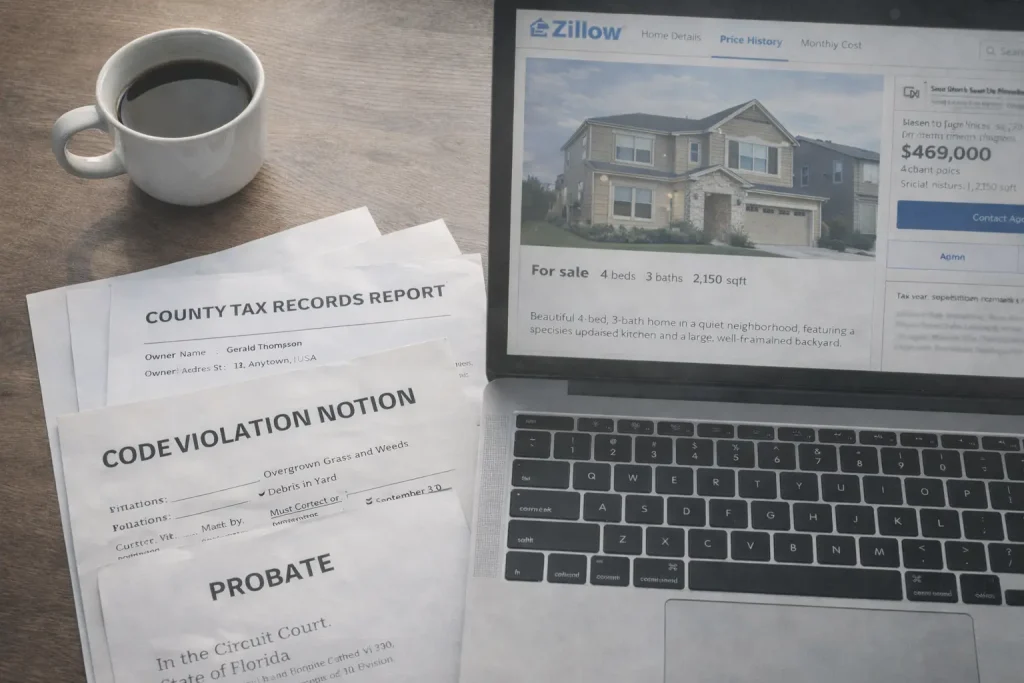
Zillow is useful because it surfaces signals, not because it tells the full story. The platform shows what is marketable, not what is complicated. Investors who go deeper are not finding secret listings. They are filling in the gaps Zillow leaves out.
That extra context is often where real leverage lives.
Code Violations That Never Appear on Listings
Code violations are rarely disclosed in listings unless they are unavoidable. Open permits, safety citations, or unresolved compliance issues live in municipal databases, not on Zillow. These issues can limit financing, delay closings, or scare off retail buyers.
From an investor perspective, they also explain why a property is sitting. A seller dealing with unresolved violations often wants speed and certainty more than top dollar.
Ignoring this layer means missing the reason behind the stagnation.
Probate and Estate Situations Zillow Cannot Flag
Probate and estate sales are governed by timelines that have nothing to do with market conditions. Heirs may want liquidity. Executors may need court approval. Deadlines are often fixed and non negotiable.
Zillow does not label this context clearly. At best, you may see vague estate language buried in the description. Investors who check court records or ownership changes understand why flexibility exists even when the house looks fine.
Motivation is often procedural, not emotional.
Tax Delinquencies That Create Quiet Pressure
Unpaid property taxes create compounding pressure over time. Penalties accrue. Notices escalate. Eventually, the risk of tax sale becomes real. None of this is visible on Zillow.
When a property has been listed longer than expected, tax stress can be a hidden driver. Sellers may be trying to solve a problem quietly before it becomes public.
Taxes do not care about market timing.
HOA Issues That Limit the Buyer Pool
HOA restrictions, disputes, or pending assessments rarely show up clearly in listings. Rental caps, litigation, or special assessments can dramatically shrink the pool of qualified buyers.
When a listing sits in an HOA heavy area, the issue is often structural rather than cosmetic. Investors who understand these constraints can price risk accurately while others walk away.
Fewer buyers usually means more negotiating room.
Tenant and Eviction Risk Hidden Behind Occupancy
Occupied properties behave differently than vacant ones. Tenant payment issues, lease terms, or eviction backlogs can all influence seller urgency. Zillow does not surface this risk cleanly, and many listings avoid mentioning it at all.
Investors who verify occupancy and local eviction timelines understand why a seller might prioritize a clean exit over maximizing price.
Complexity creates opportunity when you are prepared for it.
Learning how to find distressed properties on Zillow requires accepting what the platform is and what it is not. Zillow is a signal generator, not a full data source. The edge comes from knowing where to look next once a signal appears.
How Experienced Investors Layer Zillow With Outside Data
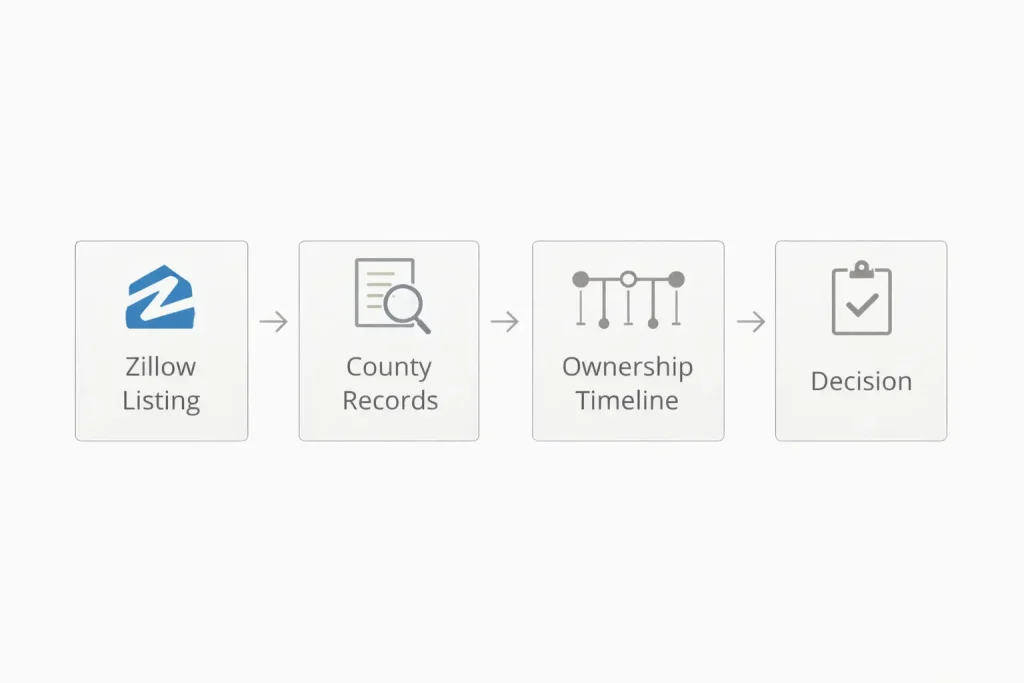
Experienced investors do not use Zillow as a decision engine. They use it as a starting point. Once a listing triggers interest, the real work happens off platform. This is how leverage is added without complexity.
Zillow tells you where to pay attention. Outside data tells you why.
Cross Checking Addresses With County Records
The first layer most investors add is county data. Ownership records reveal how long someone has held the property, whether there have been recent transfers, and sometimes how the property was acquired. That context matters more than the listing description.
Short ownership periods can signal flips or failed strategies. Long ownership can signal equity, fatigue, or life stage changes. Zillow shows the house. County records show the timeline behind it.
Timelines explain motivation.
Watching Ownership Duration Instead of Asking Why It Is for Sale
Ownership duration is a quiet filter. Properties owned for decades behave differently than ones bought recently. Long term owners are often more flexible on terms. Recent buyers are often constrained by loan balances.
Investors rarely ask why a seller is selling. They infer it. Ownership length, combined with days on market, often tells the story without a conversation ever happening.
Context reduces guesswork.
Tracking Neighborhoods Instead of Individual Listings
New investors chase listings. Experienced investors track neighborhoods. When multiple properties in the same area start sitting longer or reducing prices, it signals a local shift in demand.
Zillow makes it easy to watch clusters of activity. Saved searches and map views allow you to see patterns that individual listings hide. One stale listing is noise. Several in the same pocket is information.
Markets move in groups, not isolation.
Using Zillow Alerts as Early Warning Systems
Alerts are most effective when they are not used for speed. Instead of reacting to new listings, investors use alerts to monitor changes. Price reductions, re listings, or extended time on market trigger review, not immediate action.
This turns Zillow into a passive monitoring tool. You are not hunting constantly. You are waiting for behavior to confirm pressure.
Learning how to find distressed properties on Zillow becomes much easier when you stop trying to out click everyone else.
Zillow shows where to look, not what to decide.
Are Zillow Distressed Deals Still Worth It?
Zillow is more competitive than it used to be, but that does not mean it is inefficient. The inefficiency has simply shifted. Speed used to be the advantage. Patience is.
Most buyers and agents are still optimized to react quickly. Very few are willing to watch the same listings for months.
Why Competition Is Higher but Inefficiency Still Exists
More eyes are on Zillow than ever before. That increases surface level competition, especially on clean, well priced listings. What has not increased is follow through. Attention is abundant. Sustained observation is rare.
Most users move on after a few scrolls. They do not revisit the same properties week after week. That creates inefficiency in plain sight. Listings that do not sell immediately slowly fall out of focus, even though pressure continues to build behind them.
The crowd is loud at the beginning and silent at the end.
When Zillow Works Best in Today’s Market
Zillow performs best in slower markets where urgency is uneven. In these environments, days on market stretch and sellers experience fatigue in stages rather than all at once. That makes behavioral signals easier to spot.
Fatigue zones also matter. These are pockets where listings routinely overstay their welcome due to pricing inertia or changing demand. Overpriced listings with aging sellers tend to cluster here, especially when expectations were set during stronger markets.
Time works in your favor in these conditions.
When Zillow Should Not Be Your Only Strategy
Zillow should not be treated as a complete acquisition strategy. It does not capture early off market distress or private life events. Investors relying solely on Zillow are always reacting to what is already public.
The platform works best as a signal layer that informs where deeper investigation is worth the effort. Without that second step, Zillow becomes just another scrolling habit.
Understanding how to find distressed properties on Zillow means knowing its limits as well as its strengths.
Zillow rewards patience more than speed now.
The Simple Framework Agents Rarely Use
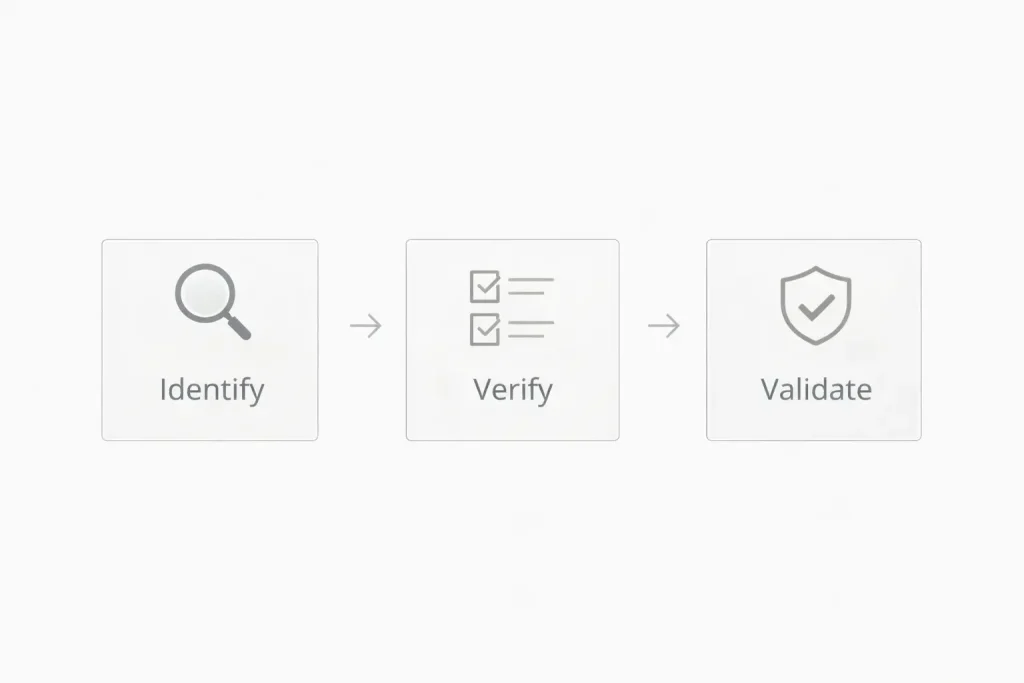
Most people fail on Zillow because they jump straight to conclusions. They see a price, glance at comps, and decide too quickly. This framework slows that impulse down and replaces it with structure.
It is simple on purpose. Simple systems get used.
Identify Unusual Listing Behavior
The first step is noticing what does not fit. This has nothing to do with whether you like the house. You are scanning for behavior that breaks the local norm.
Listings that sit longer than their neighbors. Homes that cycle through price changes without traction. Descriptions that quietly shift tone. Photos that never get updated. These are not random. They are signals that something is off relative to the market around them.
If a listing behaves differently, it deserves attention. Normal listings blend in. Unusual ones are worth tracking.
Verify Seller Pressure Indicators
Once a listing stands out, the next step is confirmation. You are not guessing motivation. You are stacking evidence.
Days on market combined with price history. Language changes paired with reduced activity. Vacancy clues layered with ownership duration. Each signal alone is weak. Together, they paint a clear picture.
Verification is about patience. Pressure reveals itself over time. Zillow gives you the timeline. You decide when the pattern is real.
Validate Pricing Against Reality Not Just Comps
The final step is grounding the opportunity in reality. Comps tell you what sold. They do not tell you what this seller will accept.
Validation means asking whether the price reflects today’s demand, the property’s condition, and the seller’s position. A listing can be overpriced and still be a deal if pressure is building fast enough. Another can be fairly priced and still go nowhere if the seller is immovable.
This is where most people stop too early.
Learning how to find distressed properties on Zillow is not about clever tricks. It is about running the same simple framework consistently. Identify behavior. Verify pressure. Validate reality. Most agents skip this because it takes time. That is exactly why it works.
Zillow Isn’t the Problem, Shallow Reading Is

Most people use Zillow like a feed. They scroll, glance, and move on. Listings blur together because nothing forces them to slow down and observe what is actually changing over time. The result is constant motion with very little insight.
Agents operate under a different constraint. Their job is to transact, not to hunt for asymmetry. They focus on what will move cleanly, finance easily, and close predictably. That makes sense for their business model, but it leaves entire pockets of opportunity untouched.
Your advantage is not access. Everyone has the same listings. Your edge is interpretation. You are not looking for prettier houses or better filters. You are reading behavior, timelines, and pressure where others only see presentation.
Learning how to find distressed properties on Zillow comes down to this shift. You stop asking what the house looks like and start asking what the seller is experiencing. When you do that consistently, patterns emerge that most people never notice.
The best distressed properties on Zillow don’t look distressed until you understand what others ignore.