

Why Off Market Leads Break Most CRMs
Most CRMs were not built for how real estate investors actually find deals. If you are working off market leads, you already know this. The moment you try to force a crm for real estate investors to behave like an agent tool, things start breaking. Leads fall through the cracks. Follow ups get missed. Deals quietly die months before they ever had a chance.
Off market leads do not behave like retail buyers or sellers. There is no clean timeline. No clear urgency. No neat decision window. That is why investors who want consistency eventually start building systems around how deals are actually sourced, tracked, and nurtured over time. I break this down more broadly in my guide on real estate investing tools, which covers how serious investors structure their entire deal finding stack instead of relying on one piece of software.
This post zooms in on one specific part of that system. The CRM. Not as a piece of tech, but as the control center that keeps off market opportunities alive long enough for timing to work.
What Makes Off Market Leads Fundamentally Different
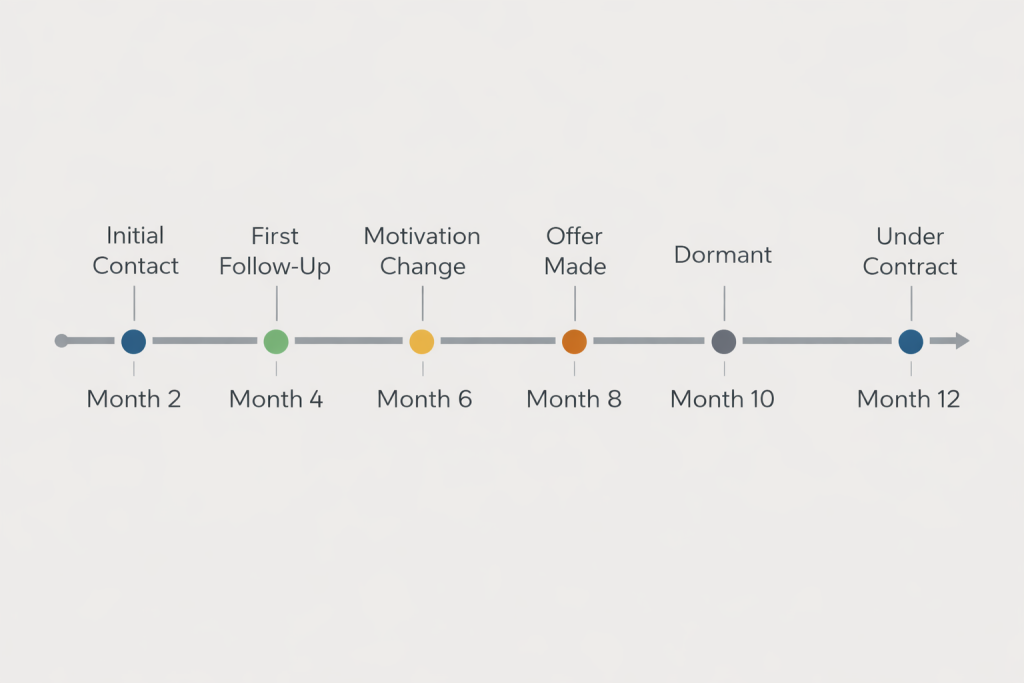
Off market leads behave differently because the seller is not actively trying to sell. That single fact changes how a crm for real estate investors needs to function. If the system assumes urgency, clarity, or clean timelines, it will break almost immediately.
Before comparing tools or features, it matters to understand why these leads behave the way they do. Once that clicks, the CRM requirements become obvious.
Long Nurture Cycles Are the Norm, Not the Exception
Off market deals rarely close quickly. Thirty days is aggressive. Ninety days is common. Six to twelve months happens more than people like to admit.
Most leads are not saying no. They are saying not yet. Life has not forced a decision, or the seller is still avoiding reality. CRMs built for transactions tend to treat silence as failure, which causes investors to abandon leads too early.
A system that does not account for long nurture cycles quietly destroys future deals.
Sellers Have Multiple, Shifting Motivations
Off market sellers almost never have a single reason for selling. It is usually a combination of money stress, emotional attachment, uncertainty, and fear of the unknown.
Motivation can increase after a missed payment, a tax notice, or a family issue. It can also disappear temporarily when things feel stable again. Traditional CRMs are bad at capturing this because they expect fixed intent instead of moving targets.
Investors need a system that tracks context, not just status.
Pricing and Timelines Are Uncertain by Design
Retail sellers anchor to comps. Off market sellers anchor to what they need, what they owe, or what feels fair to them emotionally.
Timelines work the same way. A seller may say they want to sell immediately, then delay for months once reality sets in. This is not dishonesty. It is human behavior under stress.
A CRM that assumes predictable pricing and clean timelines will constantly feel out of sync with reality.
Fallout Rates Are High and That Is Normal
Most off market conversations do not turn into deals. Some stall permanently. Others go quiet and come back to life months later.
This fallout is not inefficiency. It is filtering. The mistake is deleting or forgetting these leads instead of parking them in a structured follow up system.
High fallout only becomes a problem when there is no way to revive relationships later.
Repeated Touchpoints Are the Deal
Off market investing is won through repetition, not speed. Calls, texts, notes, reminders, and small check ins compound over time.
Once lead volume increases, memory becomes the biggest liability. Relying on mental notes or spreadsheets guarantees missed follow ups.
This is the moment where most people realize the truth.
Off market investing is a relationship management game, not a listing management game. The right CRM does not push you to close faster. It keeps you present long enough for the deal to eventually close.
Why Traditional Real Estate CRMs Fail Investors
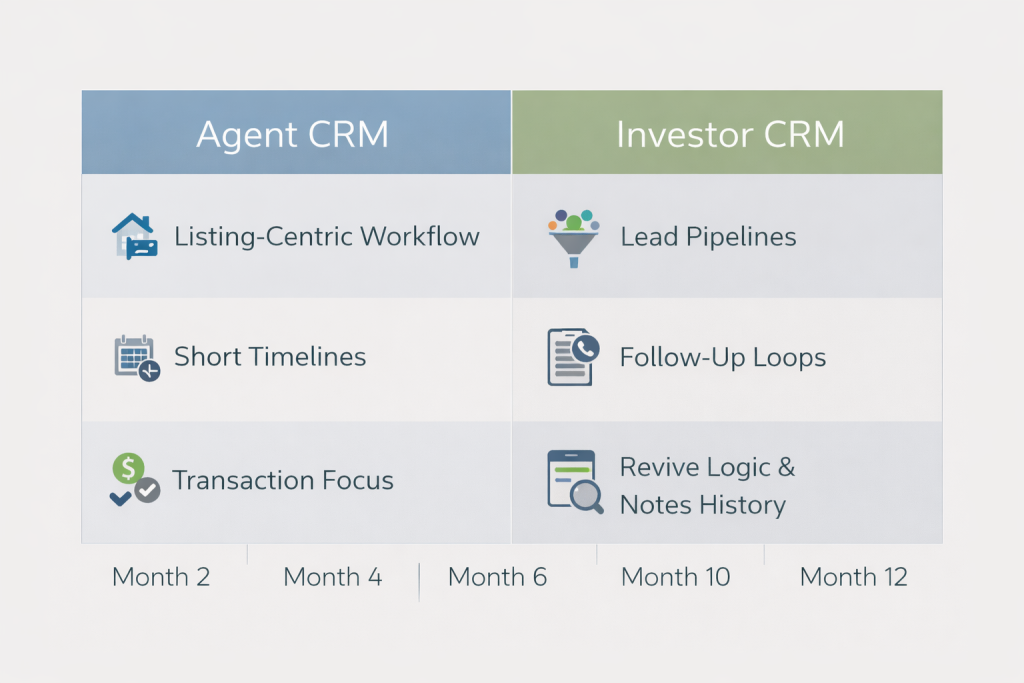
Most traditional CRMs fail real estate investors because they were never designed for how investors actually work deals. They assume clarity, urgency, and clean transactions. Off market investing is the opposite of all three. When the underlying assumptions are wrong, even powerful software becomes friction.
This is not about bad tools. It is about bad fit.
Built for Listings, Not Lead Pipelines
Traditional real estate CRMs are built around listings and transactions. The workflow assumes a property is listed, marketed, shown, and closed within a defined window. That structure collapses when you are dealing with off market leads.
Investors are not managing listings. They are managing conversations, uncertainty, and timing. Lead pipelines need to reflect stages like contacted, warming up, stalled, revived, and dormant. Most CRMs flatten everything into contacts or opportunities, which hides where the real work actually is.
When your CRM cannot show you where leads truly stand, it becomes a digital address book instead of a decision tool.
Weak Follow Up and Rigid Deal Stages
Follow up is where off market deals are won, yet most CRMs treat it as an afterthought. Reminders are shallow. Automation is rigid. Once a lead goes quiet, the system quietly gives up.
Deal stages are usually fixed or hard to customize. That forces investors to bend their process to the software instead of the other way around. Even worse, dead leads often stay dead because there is no clean way to revive them without rebuilding the record.
This is how long term equity gets lost without anyone noticing.
No Investor Specific Metrics or Context
Traditional CRMs track activity that matters to agents, not investors. Calls made, emails sent, deals closed. What they do not track well is context.
Investors need to see motivation notes, time since last contact, reason for stall, and probability over time. There are no investor specific KPIs built around nurture length, revival rates, or follow up consistency.
This is why platforms like Salesforce often feel overwhelming and misaligned. They are powerful but expensive and complex for a simple investor workflow. Tools like HubSpot skew marketing first and deal second, which works for funnels but not negotiations.
The takeaway is simple. A CRM that is not built for investor behavior will always feel heavy, frustrating, and underperforming. The failure is structural, not personal.
What an Investor CRM Must Do for Off Market Leads
An investor CRM must be built around behavior, not optimism. Off market leads require structure that assumes delays, uncertainty, and repeated contact over long periods of time. If a crm for real estate investors does not support this reality at a systems level, it will fail no matter how good the interface looks.
This section matters because features are not equal. Some are optional. These are not.
Custom Deal Pipelines Built for Investors
An investor CRM must center around deal pipelines, not contacts. Contacts are static. Deals are dynamic.
Off market investing requires stages that reflect reality such as contacted, motivation identified, follow up, stalled, revived, and dead for now. These stages must be fully customizable so the pipeline mirrors how deals actually move, not how software designers think they should move.
If you cannot look at your pipeline and instantly understand where attention is required, the CRM is not doing its job.
Automated Follow Up Across Multiple Channels
Follow up cannot depend on discipline or memory. It must be automated.
That includes text messages, emails, and task creation tied to deal stages. When a lead moves into follow up or nurture, the system should automatically schedule future touches without manual input.
This removes emotion from the process. You are no longer guessing who to call next. The system tells you.
Lead Source Tracking That Actually Matters
Off market investors generate leads from many sources. Direct mail. Cold calling. PPC. Referrals. Driving for dollars.
An investor CRM must track lead source at the deal level so you can see which channels produce real contracts, not just conversations. This is the only way to allocate marketing spend intelligently over time.
Without this, decisions are based on gut feel instead of data.
Status Cycling for Dead and Revived Leads
Dead leads are rarely dead forever. They are dormant.
A proper CRM allows leads to move backward and forward through stages without friction. A stalled lead should be easy to revive months later with full context intact. Notes, history, and prior touchpoints should be instantly visible.
This is where most traditional CRMs quietly lose equity.
Centralized Notes, History, and Forced Tasks
Every call, note, and message must live in one place. Context matters when conversations restart after long gaps.
Task reminders must be unavoidable. If a CRM allows you to ignore follow up indefinitely, it is not protecting your business. The system should surface what needs attention daily without relying on memory.
The takeaway is simple. If your CRM does not force follow up, it is not an investor CRM.
The Ideal Off Market Deal Flow (How Investors Actually Close)
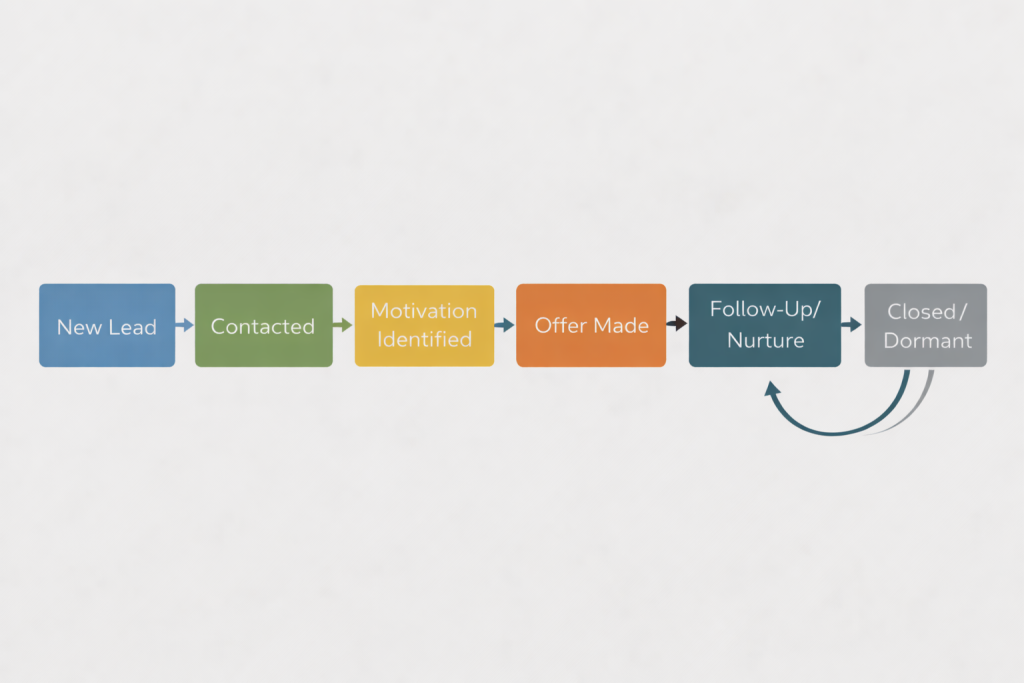
Off market deals close through progression, not pressure. The ideal deal flow accepts uncertainty and builds structure around it. When a crm for real estate investors mirrors how deals actually move, closing becomes a byproduct of consistency instead of luck.
This is not theory. This is how experienced investors keep deals alive long enough for timing to work in their favor.
New Lead to Contacted
Every deal starts as noise. A phone call, form fill, text reply, or referral.
The only job at this stage is contact. Not selling. Not analyzing. Just confirming the person exists and opening a line of communication. Many investors fail here by overthinking the first touch.
A CRM should clearly separate untouched leads from contacted ones so nothing sits unnoticed.
Contacted to Motivation Identified
This is where real work begins.
Motivation is rarely obvious on the first call. It often takes multiple conversations to understand why the seller might sell and what problem they are actually trying to solve. Financial stress, time pressure, inheritance issues, or simple burnout all show up differently.
Your CRM should capture motivation notes clearly so future conversations pick up where the last one ended.
Motivation Identified to Offer Made
Offers do not mean commitment. They mean clarity.
Once motivation exists, pricing conversations can happen. That does not mean the seller accepts. It means expectations are now on the table. Many deals stall here, and that is normal.
A good CRM treats offers as milestones, not finish lines.
Follow Up and Nurture Is Where Deals Are Won
Most off market deals live here.
This stage can last weeks or months. Life changes. Situations evolve. Stress builds. Follow up is not pestering. It is staying relevant until the timing aligns.
Your system should assume leads will sit here and make continued contact unavoidable.
Under Contract to Closed or Dead
Under contract is rare compared to the volume of leads that enter the pipeline. Closing is even rarer.
Dead does not mean failure. It means no deal right now. The critical distinction is whether dead leads are deleted or parked.
Dead is often just not yet.
Sellers come back after job loss, tax notices, tenant issues, or family changes. If the CRM preserves context and allows easy revival, those leads can move forward again without starting from zero.
The investors who close consistently are not faster. They are simply the ones still there when the timing finally works.
CRM Setup Matters More Than CRM Choice

CRM failure is rarely a software problem. It is almost always a setup problem. Investors jump between tools hoping the next platform will fix missed follow ups, disorganization, or inconsistency. It never does. A crm for real estate investors only works when the structure behind it is intentional.
The tool does not create discipline. The system does.
No Defined Pipeline Means No Clarity
Without a defined pipeline, every lead feels the same. New conversations blend with old ones. Hot opportunities get buried next to cold names.
A pipeline is not just visual organization. It is decision support. It tells you where attention should go today and what can safely wait. When stages are vague or missing entirely, the CRM becomes a storage bin instead of a control panel.
Clarity disappears fast when everything looks equal.
No Follow Up Rules Creates Silent Failure
Most investors believe they follow up well. The data usually disagrees.
Follow up rules remove emotion and guesswork. How often to touch a lead. When to pause. When to escalate. When to revive. Without rules, follow up depends on mood, memory, and motivation.
That is how deals die quietly. Not from rejection, but from neglect.
No Daily CRM Habit Breaks the System
Even a well designed CRM fails without daily interaction.
Successful investors do not open their CRM randomly. They treat it like a daily operating system. Tasks are reviewed. Pipelines are scanned. Follow ups are executed before anything else pulls attention away.
Without a daily habit, the CRM becomes reactive instead of proactive.
Discipline Beats Power Every Time
A mediocre CRM used daily with discipline will outperform a powerful platform that gets ignored. Complexity does not compensate for inconsistency.
Most investors do not need more features. They need fewer decisions. A simple system used the same way every day compounds faster than any advanced automation left unused.
This is the core Systems and Habits principle. The CRM should pull you into action. It should surface what matters and demand attention. If it waits for motivation, it will always lose.
Best CRM Types for Off Market Real Estate Investors
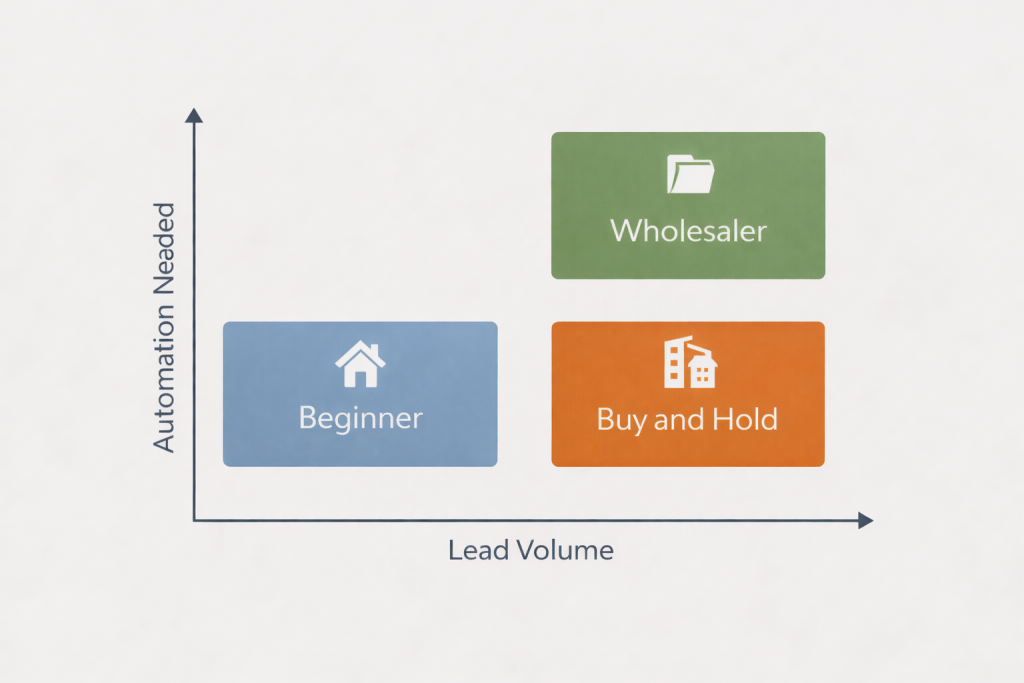
There is no single best crm for real estate investors. The right CRM depends on how you actually operate today. Most mistakes happen when investors choose tools based on brand hype or future plans instead of current behavior.
Segmenting by strategy removes confusion fast.
Beginner and Solo Investors
Beginner and solo investors need simplicity more than power. The goal is to build consistency, not complexity.
At this stage, the CRM should provide a clear pipeline, basic follow up reminders, and flexibility without overwhelming automation. Too many features early on usually lead to avoidance instead of adoption. Cost matters as well, because marketing and deal education already stretch budgets.
A platform like Podio fits well here because it allows customization without forcing a rigid structure. When set up correctly, it grows with the investor instead of boxing them in.
The priority is building the daily habit and understanding deal flow before scaling up.
Wholesalers and Lead Heavy Operators
Wholesalers and lead heavy operators have a very different problem. Volume.
When dozens or hundreds of leads are coming in each month, manual follow up breaks down quickly. Speed still matters, but consistency matters more. Every missed follow up compounds into lost assignment fees.
These investors need CRMs built around automation. SMS sequences, call tracking, task creation tied to deal stages, and visibility across team members are no longer optional. The system must handle repetition without relying on memory.
Tools like InvestorFuse and REsimpli are designed for this environment. They prioritize lead flow, follow up automation, and pipeline visibility at scale.
Here, the CRM becomes the operating backbone, not just an organizer.
Buy and Hold and Long Cycle Investors
Buy and hold investors play a longer game. Their edge comes from patience, relationships, and timing.
These investors need CRMs that emphasize notes, context, and long term reminders. A lead that does nothing for six months may become a deal after a tenant leaves or finances change. Revive logic matters more than speed.
The CRM should make it easy to pause, revisit, and re engage leads without losing history. Timelines and memory support become critical once holding periods stretch into years.
For long cycle investors, the CRM is less about closing quickly and more about staying present long enough for the right moment to arrive.
What matters most is alignment. The best CRM is the one that matches your current strategy and forces the right behavior every day.
Common CRM Mistakes That Kill Off Market Deals
Most off market deals are not lost to competition. They are lost to small, repeatable mistakes that compound quietly over time. The CRM does not fail all at once. It fails in subtle ways that feel harmless until months later when the pipeline is empty.
These are the mistakes that show up again and again.
Treating the CRM Like a Contact List
The fastest way to neutralize a crm for real estate investors is to use it like a digital Rolodex.
When leads are stored without stages, context, or intent, everything looks the same. Hot conversations sit next to cold names. Old leads never surface again. Nothing tells you where to focus.
A CRM that only stores information without guiding action becomes passive. Off market deals require active management, not record keeping.
Relying on Memory Instead of Follow Up Automation
Memory does not scale. It degrades under pressure.
Many investors believe they follow up consistently until lead volume increases. Calls get delayed. Notes get skipped. Good conversations fade simply because there was no system forcing the next touch.
Without automation for tasks, reminders, or sequences, follow up depends on motivation. Motivation is unreliable. Systems are not.
Skipping the Daily Task Review
A CRM only works when it is checked daily. Not weekly. Not when things slow down.
The daily task review is what keeps deals alive. It surfaces who needs attention, which conversations are aging, and where momentum is stalling. When this habit disappears, the CRM becomes reactive instead of preventative.
Missed days turn into missed deals faster than most people expect.
Over Customizing Before the First Deal
Customization feels productive, but early on it is often avoidance.
Investors spend hours tweaking pipelines, fields, and dashboards before they have validated their process. The result is a complex system built on assumptions instead of experience.
A simple pipeline that reflects reality will outperform a perfect system that never gets used.
Switching CRMs Instead of Fixing Behavior
Changing tools feels like progress. It rarely is.
Most CRM switches happen because the same underlying issues follow the investor from platform to platform. No follow up rules. No daily habit. No accountability.
Until behavior changes, no CRM will feel right.
The takeaway is uncomfortable but freeing. Off market deals die from neglect, not lack of software. Fix the system first. The tool only amplifies what is already there.
How to Choose the Right CRM (Simple Decision Framework)
Choosing the right CRM does not require a comparison spreadsheet or weeks of research. It requires honesty. Most confusion comes from trying to select a system for a future version of your business that does not exist yet. A crm for real estate investors should support how you operate today, not how you hope to operate one day.
These questions bring clarity fast.
How Many Leads Per Month Am I Managing
Lead volume determines complexity.
If you are handling a handful of leads each month, simplicity matters more than automation. You need visibility and reminders, not advanced workflows. As volume increases, manual follow up breaks down quickly and automation becomes necessary.
Choosing a CRM that exceeds your current volume creates friction instead of leverage.
How Long Is My Average Deal Cycle
Deal length matters more than most people realize.
Short cycles favor simplicity and speed. Long cycles demand structure, memory support, and revive logic. If your deals routinely stretch beyond a few months, your CRM must preserve context over time or you will constantly restart conversations from scratch.
Match the system to the time horizon you actually experience.
Do I Need Automation or Just Reminders
Automation is powerful, but it is not always required.
Solo investors with low volume often benefit from clear task reminders rather than full automation. Teams or high volume operators need automation to maintain consistency and avoid burnout.
If you automate before understanding your process, you automate confusion.
Am I Operating Solo or With a Team
Teams introduce complexity instantly.
Once multiple people touch the same lead, visibility, accountability, and role clarity matter. Solo operators can rely on simpler structures. Teams need systems that prevent duplication, missed handoffs, and lost context.
The CRM must reflect how many people are touching each deal.
Budget Versus Time Tradeoff
Every CRM decision is a tradeoff between money and time.
Cheaper tools often require more manual effort. More expensive tools reduce labor but demand discipline and setup. There is no wrong choice, only misalignment.
Be honest about what you can afford financially and what you can afford to manage mentally.
The rule is simple. Choose the CRM that matches your current operation, not your fantasy one. Systems work best when they grow with you instead of fighting you from day one.
CRM Is an Equity Tool, Not a Tech Tool

A CRM is not a productivity app. It is not a database. It is not a piece of software you check when you remember. A crm for real estate investors is an equity tool, whether you treat it that way or not.
Every missed follow up is lost equity. Not hypothetically. Literally.
Off market deals are created by attention over time. When follow up stops, attention stops. When attention stops, timing passes to someone else. The equity did not disappear. It just transferred to the investor who stayed in the conversation longer.
This is why systems matter more than effort. Effort is inconsistent. Systems are not.
A properly built CRM scales attention. It allows you to stay present in dozens or hundreds of conversations without relying on memory or willpower. It surfaces who needs attention today, who can wait, and who is ready to move forward again. That is leverage.
Most investors think leverage only shows up in financing. It also shows up in systems.
When your CRM is built correctly, you do not feel busy. You feel focused. Decisions get easier. Follow up becomes routine instead of emotional. Deals stop slipping away quietly.
The mistake is treating the CRM like software instead of infrastructure. Software gets evaluated on features. Infrastructure gets evaluated on outcomes.
The outcome here is simple. Did you stay in the deal long enough for timing to work in your favor.
That is why CRM is leverage. Not because of technology, but because it protects attention.