Why Most Investor Business Cards Fail
Most real estate investor business cards fail for the same reason most beginner systems fail. They are built around appearance instead of function.
The same mistake shows up everywhere in this business, from marketing to follow up to deal sourcing.
If you want to see how experienced investors actually structure their systems end to end, this follows the same thinking behind the tools covered in real estate investing tools pros use to find deals, where simplicity and timing matter more than flash.
Why Realtor Style Cards Get Thrown Away
Most investor cards copy the Realtor template without realizing it. Headshots. Brokerage style layouts. Marketing language. Too much information fighting for attention.
The problem is the audience. Motivated sellers are not comparing you to other professionals. They are trying to decide whether to act at all.
When a card looks like an agent card, it gets lumped into the same mental category as sales pressure, follow ups, and conversations they are not ready to have. So it gets discarded early.
Investor cards fail not because they look bad, but because they look familiar in the wrong way.
The One Question Every Card Must Answer
Callbacks do not happen because of design. They happen because of trust.
Days or weeks after a conversation, the seller picks up the card again and asks a quiet question. Can I trust this person to solve my problem without making it worse.
If the card feels calm, simple, and human, it stays. If it feels like marketing, it goes.
This is especially true for distressed situations. Probate. Tired landlords. Deferred maintenance. These sellers are already overwhelmed. Anything that adds friction gets filtered out.
The card’s job is not to sell. It is to wait patiently until the seller is ready.
What This Article Will Show You
This article is not about making business cards look better. It is about making them work.
You will learn what information actually belongs on a real estate investor business card, and what quietly kills callbacks. You will also see how experienced investors use cards as a silent follow up tool that works long after the conversation ends.
If your card is not generating calls when you are not in the room, it is not doing its job.
The rest of this article shows you how to fix that.
Who This Card Is Actually For (and Who It’s Not)
A real estate investor business card only works when it is designed for the right situation. If you try to make one card work for everyone, it ends up working for no one.
This section exists to filter. If this does not sound like how you operate, this approach will feel uncomfortable. That is usually a good signal.
Who This Card Is Not For
This is not for listing agents.
Agents need visibility. They benefit from repetition, brand recognition, and constant touch points. Their cards are built to be remembered immediately and shared widely.
This is also not for corporate brokerages.
Large firms rely on logos, teams, and institutional trust. Their cards represent an organization, not a person. That model does not translate well to one on one distressed conversations.
It is also not for brand first marketers.
If your goal is impressions, memorability, or visual flair, this type of card will feel underwhelming. That is by design.
Who This Card Is Built For
This card is for off market investors who operate quietly and patiently.
It is for conversations where the seller is not ready today, but may be ready later. Distressed situations. Probate and inheritance. Tired landlords who are emotionally done but not yet logically decided.
It is for driving for dollars follow ups, door conversations, and in person meetings where the relationship matters more than the pitch.
In these moments, the card is not a close. It is a placeholder.
What You Are Really Competing Against
Your business card is not competing with other investors. It is not even competing with agents.
It is competing with inaction.
Most sellers do nothing after the conversation. They delay. They avoid. They hope the problem resolves itself. Your card either blends into that delay or quietly survives it.
When a seller finds your card again weeks later, it should feel safe to call. Not urgent. Not salesy. Not demanding.
If your card can do that, it has already won.
The Psychology Behind a Callback

Callbacks are delayed by design. Sellers rarely call because of something you say in the moment. They call because of something that happens later.
Understanding that gap is the difference between cards that work and cards that disappear.
Why Sellers Almost Never Call Right Away
Most sellers are not decisive when you meet them. They are uncertain, overwhelmed, or emotionally conflicted.
The callback usually happens after the conversation, not during it.
Stress resurfaces when the situation does not improve. Another buyer flakes or stops responding. A deadline gets closer and the problem stops feeling theoretical.
When that happens, the seller does not go searching for options. They reach for the least risky one they already have.
That is where your card either helps or hurts.
What a Callback Actually Represents
A callback is not interest. It is relief seeking.
The seller is not looking for the best deal or the most aggressive buyer. They are looking for someone who feels safe to contact without opening a can of worms.
If your real estate investor business card feels like it will trigger pressure, follow ups, or awkward conversations, it gets avoided. If it feels neutral and calm, it gets used.
This is why timing matters more than persuasion.
Why Non Pushy Always Wins
A good card never demands action.
No urgency language. No calls to action. No implied next step. It exists without expectation.
That lack of pressure lowers the emotional cost of reaching out. The seller does not feel like calling means committing to anything.
When calling feels easy, it happens sooner.
Why Local and Human Matter More Than Professional
Sellers trust proximity more than polish.
A local tone suggests familiarity. A human name suggests accountability. Together, they reduce fear.
This does not require long explanations. It requires restraint.
Too much information creates distance. Minimal information creates room for trust.
Why Less Information Creates More Trust
This is the part most people get wrong.
More details feel safer to the investor, not the seller. Excess information reads like justification.
When a card only shows what matters, name, contact, and purpose, it signals confidence. It suggests you are not trying to convince anyone.
That confidence survives time.
And time is where callbacks are born.
What a Real Estate Investor Business Card MUST Include

A real estate investor business card should answer one question immediately. Who are you and how do I reach you when I am ready.
Anything that does not serve that purpose creates friction.
This section is about clarity, not creativity.
Name Comes First for a Reason
The name on the card should be a real person, not a brand.
People do not call entities. They call individuals. A personal name signals accountability and lowers the psychological barrier to reaching out.
Brand names can still exist in the background. They just should not lead the card.
If a seller is holding your card weeks later, they want to know who they are calling, not what company you represent.
One Direct Phone Number Only
Include a single phone number and make sure it rings to you or someone who answers live.
Multiple numbers create hesitation. Tracking numbers, office lines, and backups dilute the decision to call.
When a seller finally reaches out, they are not comparison shopping. They are acting on momentum. Do not make them choose.
This is one of the most overlooked details in real estate investor business cards, and it directly affects callbacks.
Email Is Optional but Signals Legitimacy
An email address is not always used, but it adds quiet credibility.
It reassures sellers that you are reachable without forcing a phone call. For some people, that matters.
Keep it simple and professional. Avoid novelty addresses or anything that feels informal.
If space is tight, email can be secondary. It should never compete with the phone number.
The Credibility Line Should Explain Without Selling
A short positioning line helps the card make sense later.
This is not marketing copy. It is context.
Good examples are plain and descriptive. Local Home Buyer. Off Market Property Purchases. Direct Buyer No Listings.
Each line answers what you do without asking for anything in return.
If it sounds like an advertisement, it is doing too much.
What Is Intentionally Left Off
Some things are missing on purpose.
License numbers do not belong on the card unless legally required. They add complexity without increasing trust in off market conversations.
Slogans and taglines are unnecessary. They take up space and often raise skepticism.
We Buy Houses language has been overused to the point of being ignored. It also signals pressure.
Social media handles distract from the only action that matters. Making the call.
A strong real estate investor business card feels incomplete to the person handing it out. That is exactly why it works for the person holding it later.
The card is not there to explain everything. It is there to be easy to use when the moment arrives.
What to Remove If You Want Callbacks
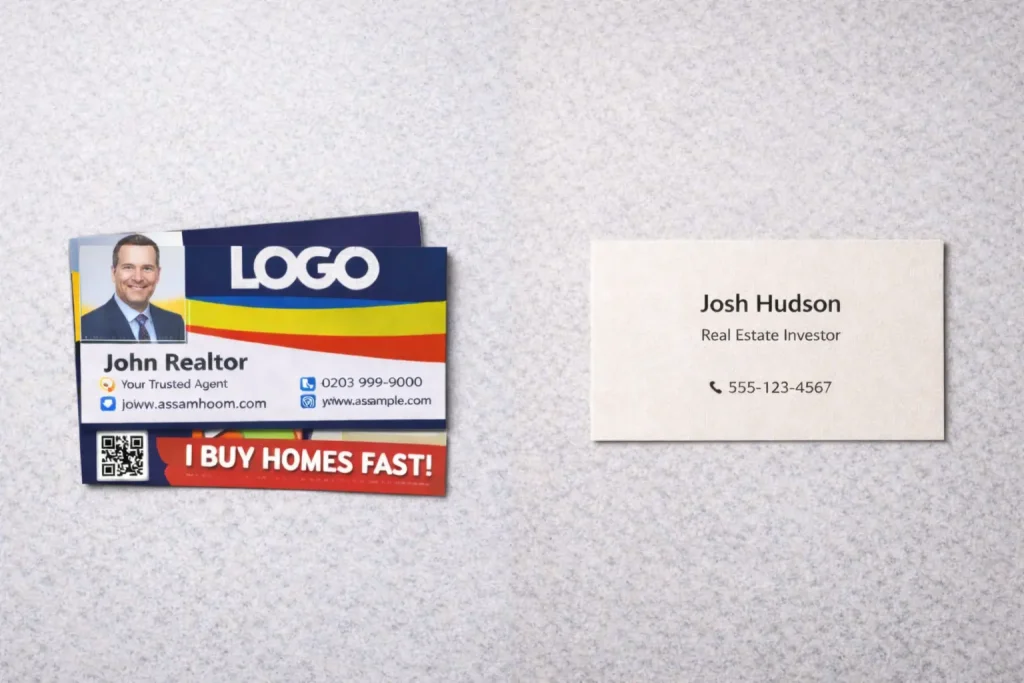
Most callback problems are not caused by what is missing. They are caused by what should not be there in the first place.
If your real estate investor business card feels busy, loud, or sales driven, it creates hesitation at the exact moment you want ease.
This section is about subtraction.
Remove Realtor Language Completely
Language borrowed from agents creates instant confusion.
Terms like listings, commissions, market experts, or trusted advisor put you in a category many sellers are already avoiding. Even if you are not an agent, the phrasing triggers the same resistance.
Sellers in distressed or uncertain situations are not looking for representation. They are looking for resolution.
The moment your card sounds like an agent card, it stops feeling safe.
Remove Loud Colors and Glossy Hype
Design communicates intent before words do.
Bright colors, glossy finishes, and aggressive contrast read as marketing. Marketing reads as pressure. Pressure creates delay.
An over designed card feels like it is trying too hard to be remembered. That effort backfires when the seller is overwhelmed.
Simple design does not mean cheap. It means calm.
Remove QR Codes That Lead Nowhere Useful
QR codes often promise convenience but deliver friction.
Sending a seller to a generic homepage forces them to think, navigate, and decide. That is work. Work kills momentum.
If a QR code does not lead to something immediately helpful and specific, it should not exist at all.
When in doubt, remove it.
Remove Any Hint of Urgency
Urgency language creates the opposite reaction you want.
Limited time. Call today. Act fast. These phrases feel manipulative when a seller is already under stress.
A card should not ask for action. It should allow it.
When the seller decides to call, it should feel like their idea, not your demand.
Why Simplicity Actually Builds Trust
Sellers associate over designed cards with follow ups they are not ready for.
Simple cards signal patience. They suggest you are comfortable waiting. That patience reads as seriousness.
A real estate investor business card should feel like it can sit on a counter for weeks without demanding attention.
The less it tries to do, the more likely it is to still be there when the moment finally arrives.
Design That Signals Trust (Not Sales)

Design is not about making your card stand out. It is about making it survive time.
A real estate investor business card should feel the same on day twenty as it did on day one. Calm. Legitimate. Unbothered.
This section is not about trends. It is about signals.
Matte Finish Over Gloss Every Time
Matte finishes reduce glare and visual noise. More importantly, they remove the feeling of advertising.
Glossy cards feel promotional. Promotional feels like pressure. Pressure delays callbacks.
A matte card blends into a kitchen counter or desk without demanding attention. That is exactly where it needs to live.
Neutral Colors Build Psychological Safety
Neutral colors do not excite. They stabilize.
Black, white, gray, muted earth tones. These colors do not compete for attention, which is the point. They feel grounded and serious without being cold.
Bright colors can work in branding. They do not work in moments of uncertainty.
When a seller rediscovers your card, neutral colors make the decision to call feel quieter and easier.
Clean Typography Communicates Confidence
Fonts tell a story before the words are read.
Clean, simple typography signals clarity. It suggests you are not hiding behind style or gimmicks. It also makes the card readable at a glance, even weeks later.
Avoid novelty fonts or anything playful. Playful is memorable in the moment and disposable later.
Readable equals usable.
Thicker Stock Feels Intentional
Weight matters more than most people realize.
A thicker card feels deliberate. It does not bend, curl, or degrade quickly. That physical durability translates into perceived reliability.
If a card feels flimsy, it feels temporary. Temporary things get tossed.
Why This Matters More Than It Sounds
Your card is not used when you hand it out. It is used when you are not there.
It sits on counters. It gets moved. It gets rediscovered.
When that happens, the design either reinforces trust or introduces doubt.
A card that still feels credible weeks later has already done its job.
Investor vs. Agent Cards: A Side by Side Breakdown
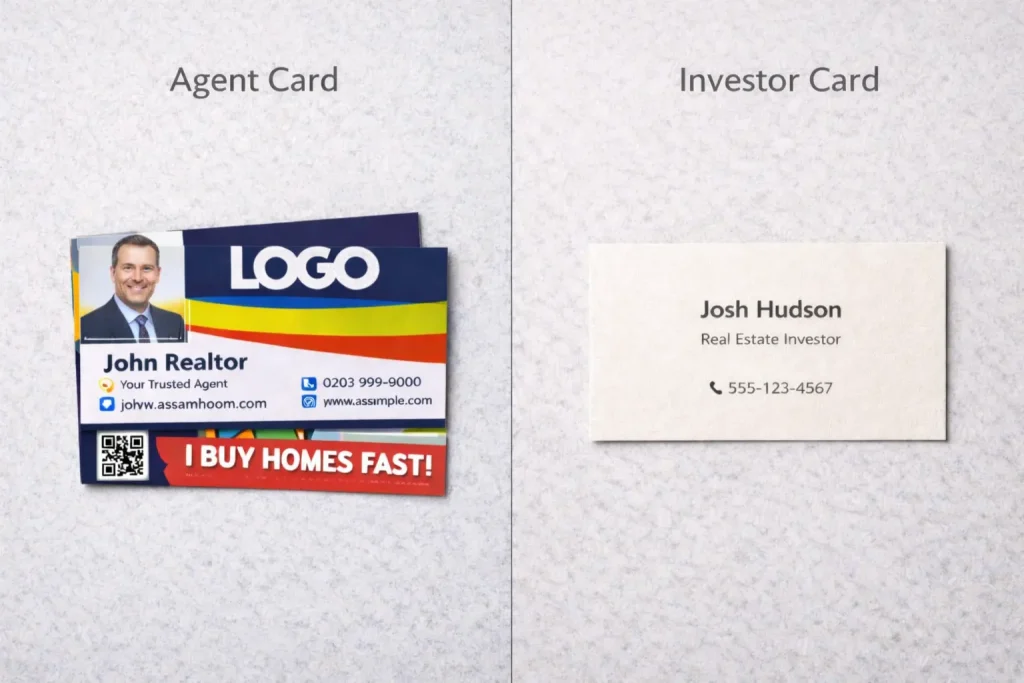
Investor cards work because they are built for a different job.
When people say business cards do not work anymore, they are usually talking about agent cards. Investor cards fail when they copy that same structure without questioning the purpose.
This is where the difference becomes obvious.
How Agent Cards Are Designed to Function
Agent cards are built for visibility.
They are brand heavy by necessity. Logos are large. Brokerage names dominate. The goal is recognition and repetition.
They include multiple ways to make contact. Phone. Email. Website. Social profiles. Sometimes all of the above. This makes sense for an agent whose job is to stay top of mind.
The language is sales oriented. Trusted advisor. Market expert. Call now. Schedule a consultation.
Agent cards are meant to prompt immediate action.
How Investor Cards Are Designed to Behave
A name leads. The identity feels individual, not institutional. That signals accountability rather than representation.
There is usually one clear way to make contact. A direct phone number. No decision tree. No options to weigh.
The language stays neutral and calm. It explains what you do without asking for anything. There is no call to action because the action is implied.
Investor cards rely on passive recall. They are designed to be remembered later, not acted on immediately.
Why This Difference Matters
When a seller compares cards in their head, they are not choosing between professionals. They are choosing whether to engage at all.
Agent cards push. Investor cards wait.
That waiting is not passive. It is strategic.
Agents chase attention. Investors wait for timing.
If your card matches the job you are trying to do, it will get callbacks. If it borrows from the wrong category, it will quietly disappear.
Use Case Examples: Where Callbacks Actually Come From

Callbacks do not come from perfect pitches. They come from quiet moments where you chose restraint instead of pressure.
This is where real estate investor business cards actually do their work.
After a Walkthrough That Did Not Close
Leaving a card after a walkthrough is one of the highest leverage moments, if you handle it correctly.
The seller already knows you are interested. They already know the property has issues. What they are unsure about is timing.
A card left without commentary signals patience. It tells them you are not forcing a decision and that you will still be there if things change.
That absence of pressure is often what brings the call later.
With a Hesitant or Emotionally Stuck Seller
Some sellers talk themselves in circles. They want relief but are afraid of regret.
In those conversations, continuing to explain or persuade usually makes things worse.
Handing over a card and stepping back does something subtle. It gives the seller control again.
When stress resurfaces, that card becomes an easy way to reopen the conversation without embarrassment.
After a Missed Door Knock
Most door knocking follow ups fail because the card feels intrusive.
A simple card left behind with no note and no urgency feels different. It reads as informational rather than solicitational.
The homeowner does not feel chased. They feel informed.
When curiosity replaces defensiveness, callbacks become possible.
Through Contractors, Neighbors, and Third Parties
Some of the best callbacks come indirectly.
A contractor passes along your card. A neighbor mentions you when someone complains about the house next door. A casual conversation turns into a referral weeks later.
In those cases, the card must explain itself without you present. Simple language and restraint make that possible.
Why Context and Restraint Work Together
In every scenario, the pattern is the same.
The context creates awareness. The restraint creates safety.
A card that does not push allows the seller to act when their internal pressure is higher than their fear. That is when callbacks happen.
If your card can sit quietly inside someone else’s life until the moment is right, it is doing exactly what it was designed to do.
Optional Add Ons That Can Increase Callbacks (If Done Right)

Once the fundamentals are in place, a few small additions can increase callbacks without turning the card into a marketing piece.
These are optional for a reason. If they introduce friction, they stop working.
A Dedicated Intake Page, Not a Homepage
If you include a website, it should point to a single purpose intake page.
Not a homepage. Not a blog. Not an about page.
The page should explain, in plain language, what happens if they reach out. Who they are contacting. What the next step looks like. Nothing more.
This works because it reduces uncertainty. Sellers are not committing to a deal. They are committing to a conversation.
Anything that requires navigation or decision making lowers follow through.
Call Tracking Numbers Only Work If Someone Answers
Call tracking can be useful, but only under one condition. Someone answers live.
Voicemail delays break momentum. Automated systems feel like customer service, not help.
If you cannot reliably answer or return calls quickly, use your direct number instead. The data is not worth the lost trust.
Callbacks are fragile. Treat them that way.
A Handwritten Note Changes Everything
A short handwritten note on the back of the card can dramatically increase callbacks.
Not a pitch. Not instructions. Just context.
Something as simple as thanks for showing me the house or call me if things change reframes the card as personal, not transactional.
This works because it anchors the card to a real moment and a real interaction. It is no longer generic.
What Still Does Not Work
Long URLs do not get typed. They also signal marketing.
Automated voicemail systems create distance. Distance creates delay. Delay kills callbacks.
If an add on does not make the card easier to use, remove it.
Optional does not mean necessary. The best real estate investor business cards still work with very little on them. These additions only help when they preserve simplicity.
At this stage, less is still more.
The Bottom Line: Your Card Is a Silent Follow Up

A real estate investor business card does not do its job during the conversation. It does its job after.
Once you understand that, the rest becomes obvious.
Why Timing Matters More Than the Handshake
Most deals do not happen when you are standing in front of the seller. They happen later, when circumstances shift and avoidance stops working.
That is when your card either helps or disappears.
If the card was designed to sell, it creates resistance. If it was designed to wait, it gets used.
Business cards are not closers. They are placeholders.
Why Forgettable First Is a Feature
The best investor cards are unremarkable in the moment.
They do not demand attention. They do not try to impress. They do not push the seller to act before they are ready.
That forgettability is intentional. It allows the conversation to end cleanly, without pressure or awkwardness.
Later, when the card is rediscovered, it feels familiar without feeling invasive.
Why Memorability Happens Later
Memorability does not come from design tricks. It comes from emotional timing.
When a seller is ready to act, they remember who felt reasonable. Who did not rush them. Who did not complicate things.
Your card becomes the easiest next step.
That is not branding. That is positioning.
The Investor Advantage Most People Miss
The best investor cards do not sell.
They wait.
They sit quietly until the seller’s internal pressure outweighs their hesitation. When that moment arrives, the card feels safe to use.
That is the entire philosophy.
If your card can do nothing for weeks and still work when it matters, you built it correctly.