Definition & Concept: What Virtual Driving for Dollars Actually Is
Virtual driving for dollars fits into a broader category of strategies most investors quietly rely on but rarely explain in full. It’s one branch of a much larger off market deal method that focuses on identifying motivated sellers before competition ever shows up.
How Virtual Driving for Dollars Differs From Traditional Driving
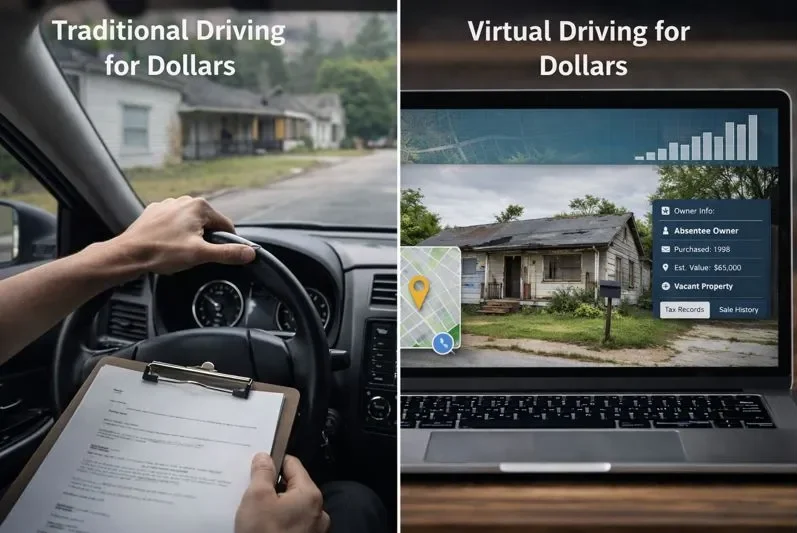
Traditional driving for dollars is local and sensory. You see the property in real time, feel the neighborhood, and catch details that don’t always show up online. The tradeoff is speed. It takes hours, fuel, and consistent physical presence in one market.
Virtual driving flips that equation. You give up some real-time context in exchange for scale. You can scan dozens of properties, across multiple neighborhoods or even cities, in a single sitting. For people with limited time or out-of-state investing goals, that shift matters.
Is Virtual Driving for Dollars Legit or Just a Buzzword?
It’s legitimate, but often misunderstood. Virtual driving doesn’t eliminate judgment or due diligence. It replaces mileage. You’re still evaluating properties one by one and filtering for motivation. The difference is that street-level imagery, maps, and public records replace your car.
When used correctly, virtual driving for dollars stops feeling like a shortcut and starts acting like a filter. It narrows your focus to properties where ownership stress is already visible, long before anything hits the market.
How Virtual Driving for Dollars Works (Step by Step)
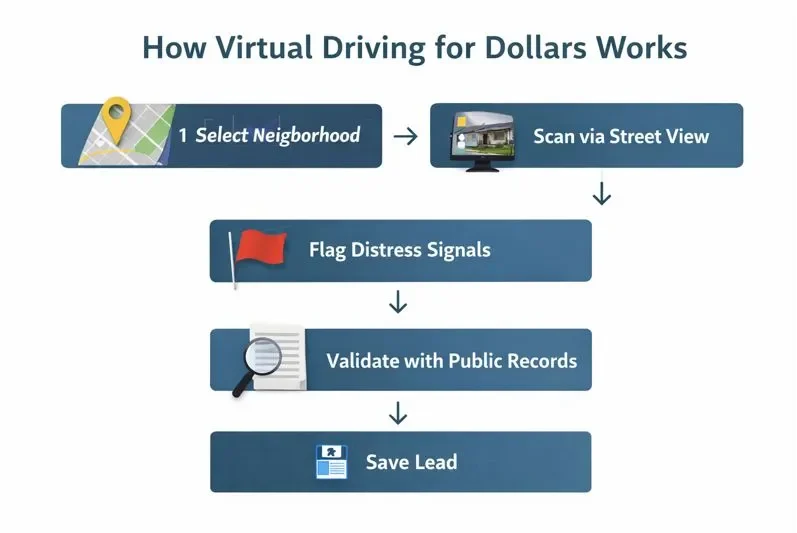
Virtual driving for dollars works by replicating what your eyes would normally catch on the road, just in a more structured way. The process starts by narrowing your focus to a specific area, usually a zip code or neighborhood that already fits your buying criteria. You are not browsing randomly. You are intentionally scanning for breakdown, neglect, or long term vacancy that suggests ownership stress.
Instead of looking out a windshield, you use street level imagery, satellite views, and map based tools to identify visual distress. Overgrown yards, boarded windows, peeling paint, tarped roofs, or vehicles that have clearly not moved in months. These are not cosmetic issues. They are surface level signals that often point to deeper financial or life disruptions behind the scenes.
Once a property stands out visually, the next step is confirmation. This is where data replaces intuition. Ownership length, absentee status, tax delinquencies, code violations, or repeated listing failures help validate whether the distress is situational or structural. One signal alone rarely means anything. Several stacked together usually do.
The final step is organization. You save the address, note why it qualified, and move on. The goal is not to chase individual properties. It is to build a consistent, repeatable lead list. Virtual driving for dollars works when it is treated like a system, not a shortcut.
What Data Signals Actually Indicate Distress
Distress is rarely obvious from one data point. It shows up when multiple indicators overlap. Long term ownership combined with visible neglect. Absentee owners paired with tax or code issues. Vacant properties with no recent sales activity. These combinations are what separate real opportunities from noise.
Public records and mapping tools do not tell you someone wants to sell. They tell you when ownership is under pressure. When those pressures persist long enough, motivation tends to follow. That is the real value of data in virtual driving for dollars.
What Replaces Your Windshield When You Go Virtual
Your windshield is replaced by layers. Visual tools show you what is happening on the surface. Property and municipal records explain what might be happening underneath. Together, they recreate the same observations you would make in person, just without the physical constraint.
When used correctly, the technology does not remove judgment. It focuses it. You still decide what matters. You just do it faster, across more ground, and with far more consistency.
Tools & Software for Virtual Driving for Dollars (What You Actually Need)
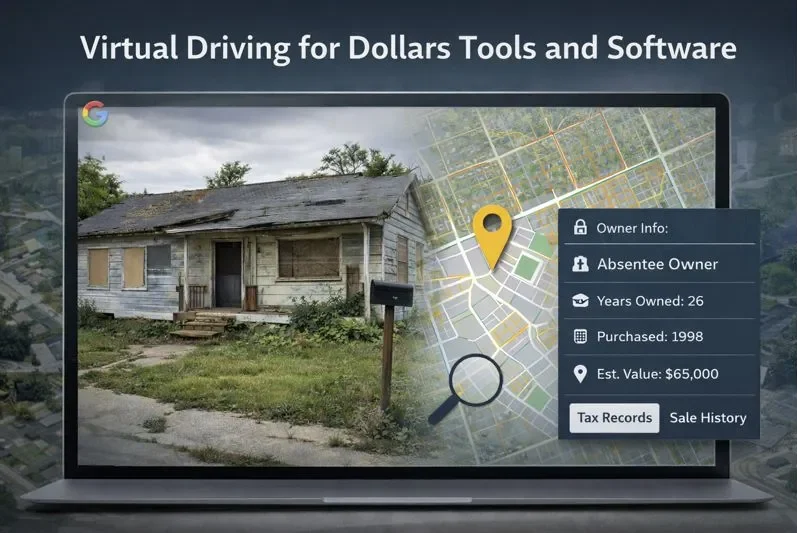
Most people searching for tools are really asking a different question. They want to know what’s essential and what’s just expensive noise. Virtual driving for dollars doesn’t require a massive tech stack. It requires the right combination of visual context and ownership data, layered in a way that makes patterns obvious.
The mistake beginners make is assuming more tools equal better leads. In reality, too many platforms slow you down and create decision fatigue. The goal is to replicate what you would notice in person, then confirm it with data. Anything beyond that should earn its place.
Visual Tools That Replace Your Windshield
Google Street View and Google Earth are the foundation. Street View replaces your eyes at ground level. You’re looking for neglect, vacancy, and physical decline that hasn’t been addressed in years. Google Earth adds historical imagery, which is quietly one of the most powerful features. Being able to see how a property looked three, five, or ten years ago tells you whether decline is recent or long-term.
Regrid and county GIS sites add another layer of context. Parcel boundaries, zoning, lot size, and sometimes ownership details help you understand what you’re actually looking at. These tools don’t generate leads on their own, but they prevent bad assumptions. That alone makes them worth using.
If your goal is pure virtual scouting, these tools can take you surprisingly far without spending a dollar.
Data Platforms That Confirm Distress
This is where paid tools like PropStream, DealMachine, and BatchLeads come in. Their value isn’t that they find properties for you. It’s that they help you validate what you already spotted. Ownership length, absentee status, tax delinquencies, code violations, and mortgage data all help answer the same question. Is this just an ugly house, or is there actual ownership stress?
DealMachine leans heavily into the driving-for-dollars workflow and is beginner-friendly. PropStream is more data-dense and better for investors who want deeper filtering. BatchLeads sits somewhere in the middle, especially if you plan to scale outreach later.
None of these are mandatory on day one. They become useful when volume increases and guesswork becomes expensive.
What’s Worth Paying For and What Isn’t
If you’re just starting, free tools will do most of the heavy lifting. Paid software makes sense only when it saves time or reduces bad leads. The worst mistake is subscribing before you understand what signals you’re actually looking for.
Virtual driving for dollars works best when tools support a process you already understand. When software becomes the process, you usually end up paying for convenience without clarity.
What to Look For in Virtual Driving for Dollars (Digital Distress Signals)
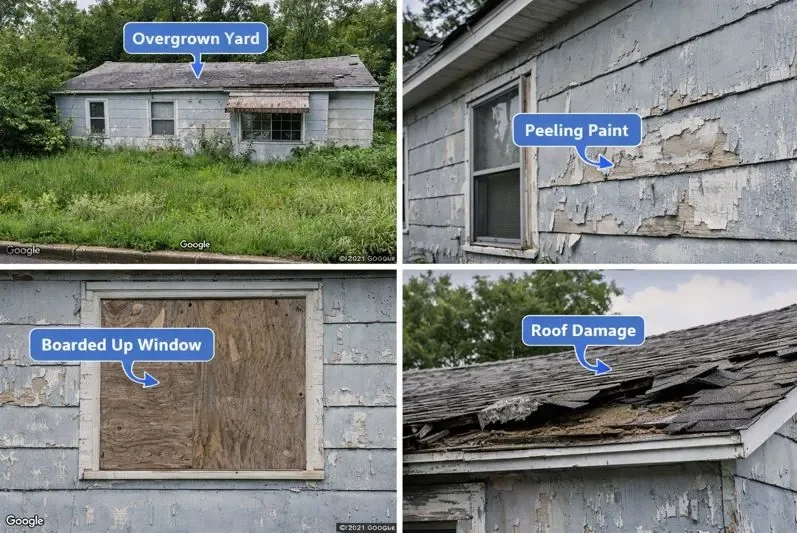
Digital distress signals are the online equivalent of what experienced investors notice instinctively in person. You’re not hunting for ugly houses. You’re looking for patterns of neglect, delay, or abandonment that suggest ownership stress. Virtual driving for dollars works when you train your eye to separate cosmetic issues from signals that persist over time.
The key is stacking indicators. One red flag rarely means anything by itself. Multiple signals pointing in the same direction usually do. That’s how you avoid chasing properties that look rough but have no real motivation behind them.
Visual Indicators You Can Spot Instantly
Some distress shows up immediately when you pull up a property online. Boarded or covered windows, overgrown yards, peeling paint, and visible roof damage are the most common. These are not just aesthetic issues. They often indicate deferred maintenance that hasn’t been addressed for years, not months.
Long-term vacancy is another strong signal. Multiple online images showing the same condition across different years usually mean the property hasn’t been actively lived in or maintained. Historical imagery is especially useful here because it removes guesswork. If nothing changes over time, something is likely broken on the ownership side.
Public Record Signals That Confirm What You’re Seeing
Visual cues are only the starting point. Public records are what turn suspicion into confirmation. Code violations suggest repeated neglect or compliance issues. Tax delinquencies often point to financial strain or disengaged ownership. Absentee ownership, especially when paired with visible decline, dramatically increases the odds of motivation.
Individually, these data points don’t mean much. Together, they form a clearer picture. A neglected home owned by someone who hasn’t lived there in years and hasn’t paid taxes on time is very different from a property that just needs a fresh coat of paint.
How to Use Comparisons Without Overanalyzing
Screenshots, examples, and before-and-after comparisons are helpful for calibration, not perfection. The goal isn’t to document every flaw. It’s to build consistency in what you flag and why. Comparing properties over time helps you recognize what normal wear looks like versus prolonged neglect.
When you stop chasing perfection and start looking for repeatable patterns, virtual driving for dollars becomes faster and more reliable. You’re no longer guessing. You’re filtering.
Is Virtual Driving for Dollars Effective Compared to Traditional D4D?
Virtual driving for dollars does work, but not in the way most people expect. It’s not better or worse than traditional driving for dollars. It’s different. Each method excels under different constraints, and understanding those constraints is what determines whether it makes sense for you.
The real question isn’t effectiveness in isolation. It’s effectiveness relative to time, location, and scale. Once you frame it that way, the tradeoffs become much clearer.
Does Virtual Driving for Dollars Actually Work?
Yes, it works when your goal is lead identification, not instant certainty. Virtual driving for dollars is excellent at surfacing properties with consistent distress patterns. It helps you narrow thousands of homes down to a manageable list of likely candidates without stepping foot in the neighborhood.
Where it falls short is context. You don’t hear the street noise. You don’t see activity patterns. You don’t catch subtle neighborhood cues. That doesn’t make the method weak. It just means its strength is filtering, not final judgment.
Can Virtual D4D Fully Replace Physical Driving?
For some investors, yes. Out-of-state buyers and people targeting multiple markets often have no practical alternative. Virtual methods allow them to operate where physical presence would be impossible or inefficient.
For local investors, replacement depends on deal stage. Virtual driving can replace the early discovery phase, but physical driving still adds value before committing capital. Seeing a property in person often confirms or kills a deal quickly. The two methods don’t compete as much as they complement.
When Combining Both Makes the Most Sense
The most effective investors use virtual driving for dollars to scale and traditional driving for dollars to verify. Virtual tools find patterns across wide areas. Physical driving adds nuance where it matters most.
If time is limited or markets are expanding, virtual comes first. If a lead looks promising or capital is on the line, in-person validation becomes the final filter. Used together, they create a system that’s both efficient and grounded.
Lead Flow and Marketing Follow Up After Virtual Driving for Dollars
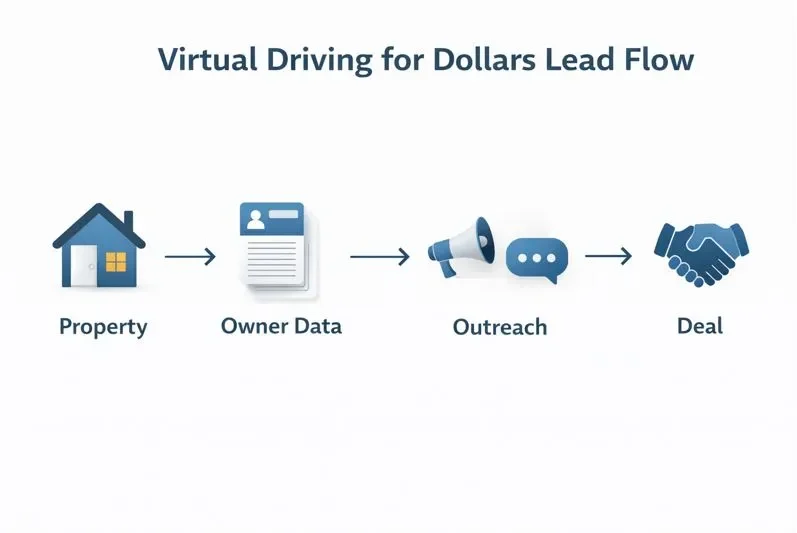
Finding properties is only the first step. Virtual driving for dollars creates a list, not a deal. The moment most people get stuck is right after that list is built. They have addresses, screenshots, and notes, but no clear path forward. This section answers the real question behind the search. What happens next?
Turning virtual leads into real deals requires a simple flow. Identify the owner. Reach out consistently. Track responses. Nothing about this part is flashy, but it’s where outcomes are decided.
How Investors Identify and Skip Trace Owners
Once a property is flagged, the next step is tying it to a real person. Public records usually provide a starting point. Ownership name, mailing address, and length of ownership are often enough to decide whether a lead is worth pursuing further.
Skip tracing comes into play when contact information is incomplete or outdated. This process connects ownership records to phone numbers, emails, and other points of contact. The goal isn’t perfection. It’s reachability. One reliable way to contact an owner is usually enough to start a conversation.
Choosing the Right Contact Method for Each Lead
Not every seller responds to the same outreach. Some prefer mail because it feels less intrusive. Others respond faster to texts or phone calls. The mistake is picking one method and assuming it should work for everyone.
Mail tends to work well for long term owners and absentee landlords. Text and cold calling can surface motivation faster but require thicker skin and better filtering. What matters most is consistency. One message rarely does anything. A simple, repeated presence often does.
Turning Conversations Into Actual Deals
A response doesn’t mean a deal is ready. Most conversations start months before a transaction happens. Virtual driving for dollars shines here because it feeds a long term pipeline instead of chasing urgent listings.
The investors who succeed treat follow up like inventory. Every conversation is logged. Every lead is revisited. Over time, motivation changes. When it does, you’re already the familiar option. That’s how virtual leads turn into real closings.
Cost, ROI, and Whether Virtual Driving for Dollars Is Beginner Friendly
Most people asking about cost and ROI aren’t trying to optimize returns yet. They’re trying to avoid wasting time and money. Virtual driving for dollars attracts beginners and side-hustle investors because it looks cheaper and more flexible than traditional methods. In many cases, it is. But the savings come with tradeoffs that matter.
Understanding those tradeoffs upfront prevents frustration later.
Is Virtual Driving for Dollars Cheaper Than Traditional D4D?
From a pure expense standpoint, yes. Virtual driving eliminates fuel, vehicle wear, and hours spent driving neighborhoods that produce nothing. Many of the core tools are free, and paid software is optional in the early stages.
The real cost shows up in time and focus. Virtual methods are easier to start but easier to misuse. Without clear criteria, people scroll endlessly and mistake activity for progress. The money saved only matters if the process stays disciplined.
Can a Beginner Actually Do This Effectively?
Beginners can do virtual driving for dollars, but only if expectations are realistic. This method does not produce instant deals. It produces early exposure to how distress actually looks, which is valuable on its own.
For new investors, the biggest benefit is education. You learn to recognize patterns, not just properties. That learning curve shortens future deal cycles, even if the first few months don’t result in a closing.
Time Commitment and When Results Usually Show Up
Most people can do effective virtual driving for dollars in three to five focused hours per week. Consistency matters more than volume. A small list built weekly compounds faster than sporadic binge sessions.
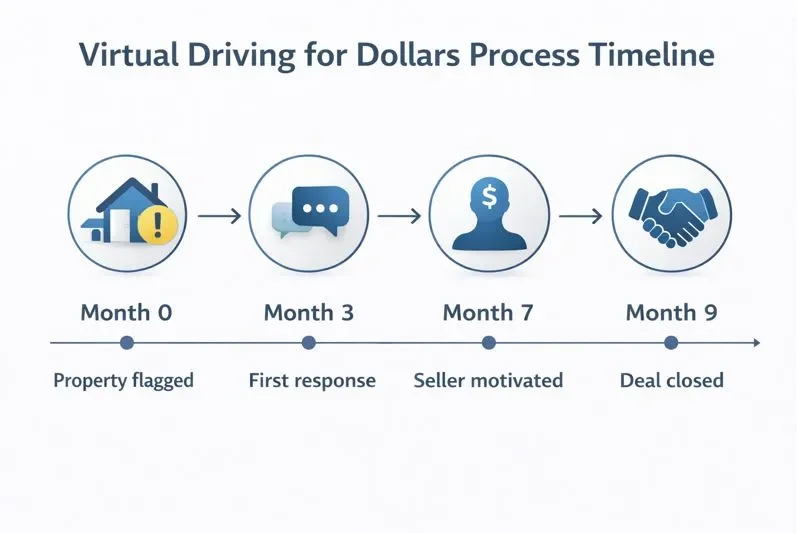
Results are rarely immediate. Conversations often begin within weeks, but deals tend to materialize months later. That delay isn’t a flaw. It’s the nature of motivated sellers. The investors who stick with it long enough usually realize the real return is leverage, not speed.
Scaling Virtual Driving for Dollars and Outsourcing the Work
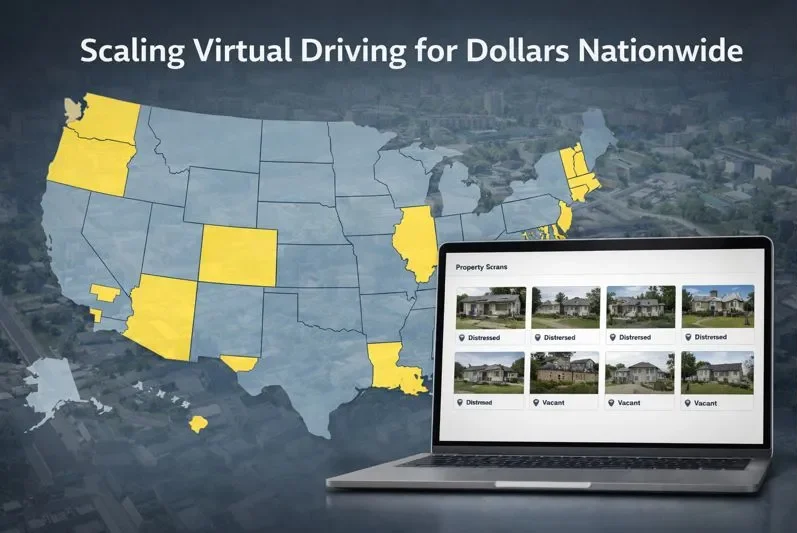
Once the basics are understood, the bottleneck shifts. The issue is no longer knowing what to look for. It’s how much ground you can cover without burning out. This is where virtual driving for dollars starts to separate itself from traditional methods. It scales cleanly, but only if the process is clearly defined.
Scaling without structure usually creates noise. Scaling with systems creates leverage.
When It Makes Sense to Hire Virtual Assistants
Virtual assistants become useful once your criteria are stable. If you’re still changing what qualifies as a lead, outsourcing too early creates inconsistent results. The moment you can explain your decision process in plain language, you’re close to being ready.
VAs are best used for the first pass. Scanning areas, flagging obvious distress, and organizing properties into a review list. Final judgment should stay with you. That separation keeps quality high while increasing volume.
Creating SOPs for Virtual Driving for Dollars
An SOP does not need to be complicated. It needs to be specific. What tools to open. What to look for. What disqualifies a property. What gets saved and why. Screenshots and examples matter more than long explanations.
The goal of an SOP is not speed. It’s consistency. When every property is evaluated the same way, scaling stops degrading quality. That’s what makes outsourcing viable instead of frustrating.
Expanding Across Multiple Zip Codes or States
Virtual driving for dollars scales geographically better than almost any other deal-finding method. You’re not limited by commute time or local presence. You’re limited by how clearly your criteria translate across markets.
When expanding, start with one new area at a time. Learn its housing stock, code enforcement behavior, and ownership patterns before adding more. Scale wide only after depth is established. That’s how advanced investors grow without losing control.
Examples, Case Studies, and Proof That Virtual Driving for Dollars Works
At this stage, most readers aren’t asking how it works anymore. They’re asking if it’s actually produced real outcomes for real people. This is trust-building intent. They want to see how virtual driving for dollars translates from theory into closed deals, not just cleaned-up screenshots or vague success claims.
The most useful examples don’t look impressive at first glance. They look ordinary. A neglected house. A missed detail. A property that sat untouched until someone noticed a pattern others ignored.
What Real Virtual D4D Deals Usually Look Like
Most virtual driving deals don’t start with dramatic before-and-after photos. They start with a boring address that checked a few quiet boxes. Long-term ownership. Deferred maintenance visible across multiple years of imagery. Absentee owner living out of state. Nothing urgent. Nothing flashy.
The deal often comes later. Sometimes months later. The investor didn’t “find” a motivated seller. They found a property where motivation eventually surfaced, and they were already in position when it did. That’s the common thread across legitimate case studies.
How Walkthroughs and Screenshots Build Confidence
YouTube walkthroughs and screen recordings help because they show the thinking, not just the outcome. Watching someone toggle between street view, historical imagery, and public records makes the process tangible. It answers the unspoken question of what decisions are actually being made on screen.
Screenshots and comparisons are most useful when they show time progression. A yard that hasn’t changed in five years. A roof that was already failing in older images. These visuals reinforce that virtual signals aren’t guesses. They’re patterns.
Understanding ROI Without Cherry-Picking Results
ROI breakdowns matter, but only when they’re framed honestly. Virtual driving for dollars doesn’t promise fast wins. It reduces acquisition cost and increases surface area. That’s where the return comes from.
Lower lead costs, fewer wasted drives, and earlier conversations compound over time. The proof isn’t one deal. It’s a pipeline that quietly produces opportunities long after the search ends.
Legal and Ethical Considerations With Virtual Driving for Dollars
This is a lower-volume concern, but it’s one of the most serious. People searching this angle aren’t trying to optimize speed. They’re trying to avoid mistakes that can create legal trouble or reputational damage. Virtual driving for dollars is powerful, but it sits close to privacy, data use, and solicitation rules that vary by location.
Being effective long term means understanding where the lines are before you get close to them.
Understanding Data Accuracy and Its Limits
Public and third-party data is not perfect. Ownership records lag. Mailing addresses go stale. Visual imagery can be months or years old. Treating any single data point as fact is where people get burned.
The right mindset is probabilistic, not absolute. Data is used to prioritize, not to accuse or assume. When you approach owners as if your information could be incomplete, conversations stay productive instead of confrontational.
Staying Compliant With Local Outreach Laws
Outreach rules vary widely by state and municipality. Mail is generally the least regulated, but even that can carry disclosure requirements in some areas. Texting and cold calling often fall under stricter regulations that govern consent, frequency, and opt-out language.
Ignoring these rules doesn’t just risk fines. It creates friction with the very people you’re trying to build trust with. Before scaling any outreach channel, understanding the local legal framework is not optional.
Navigating Ethical Concerns the Right Way
The ethical concern most people feel isn’t about legality. It’s about intent. Reaching out to someone experiencing distress carries responsibility. How you position yourself matters more than what you’re offering.
The investors who last in this space lead with clarity, not pressure. They give owners options instead of ultimatums. When virtual driving for dollars is treated as a way to offer solutions rather than extract value, both deals and reputations tend to hold up over time.