
The Hidden Cost No One Mentions
You’ve finally found the right home.
You’ve budgeted for the payment, taxes, and insurance. Then your lender sends over the final estimate, and there’s a charge you didn’t expect: mortgage insurance.
It’s not homeowners insurance. It doesn’t protect you, it protects the lender. If you put less than 20 percent down, the bank adds it as a safeguard in case you default.
So how much does mortgage insurance cost?
Usually between 0.3 and 1.5 percent of the loan amount per year on a conventional loan, while FHA loans include both upfront and monthly premiums. It doesn’t sound like much, but over the years it can add up fast.
If you want a simple overview of how to remove this cost sooner, you can check my main guide.
You can’t skip it, but you can plan to remove it. Once you hit 20 percent equity, you can often drop it or refinance out of it.
If you want to see how these costs affect your specific loan, check out the Department of Housing and Urban Development (HUD) page for detailed rate breakdowns.
What Mortgage Insurance Actually Is (and Why It Exists)

Mortgage insurance often gets mistaken for homeowners insurance, but they serve completely different purposes.
Homeowners insurance protects you if your home is damaged. Mortgage insurance protects the lender if you stop making payments.
If you put down less than 20 percent, the lender requires it to reduce their risk. It doesn’t benefit you, it benefits them.
Private Mortgage Insurance (PMI) is used on conventional loans, while FHA and USDA loans have their own versions. No matter the name, it all serves the same purpose—protection for the lender, not the borrower, even though you’re the one paying for it.
For a deeper look at how PMI works behind the scenes, visit the Federal Housing Finance Agency.
How Much Does Mortgage Insurance Cost?

Mortgage insurance costs vary based on your loan type, credit score, and down payment.
For conventional loans, private mortgage insurance (PMI) typically runs between 0.3 and 1.5 percent of your loan amount per year. On a $350,000 loan, that’s about $90 to $440 per month.
FHA loans charge a 1.75 percent upfront fee plus about 0.55 percent annually. USDA loans include a 1 percent upfront guarantee fee and 0.35 percent yearly, while VA loans charge a one time funding fee between 1.25 and 3.3 percent.
| Loan Type | Upfront Cost | Annual Rate | Duration | Example on $350k |
| Conventional (PMI) | None | 0.3–1.5% | Until 20% equity | $90–$440/mo |
| FHA | 1.75% | 0.55% | 11 years or life of loan | $205/mo |
| USDA | 1.0% | 0.35% | Life of loan | $160/mo |
| VA | 1.25–3.3% | None | One time | $4,125 one time |
If you want to run your exact numbers, you can use a quick calculator to estimate your monthly PMI based on your credit score and loan size.
You can find updated cost ranges on Consumer Financial Protection Bureau website.
What Affects the Cost

Several factors determine how much you’ll pay for mortgage insurance, and a few of them are actually within your control.
• Down payment size – the smaller your down payment, the higher your PMI rate
• Credit score – stronger credit means a lower premium
• Loan type – FHA, USDA, and conventional loans each use different formulas
• Loan term – longer loans usually carry higher PMI rates
• Occupancy type – primary homes get better rates than rentals or second homes
Pro tip: Every 20 points on your credit score could shave $20 to $50 a month off your PMI. That’s free money for simply managing credit well.
How to Avoid or Remove Mortgage Insurance

You can avoid mortgage insurance by putting down 20 percent or using a piggyback loan (an 80/10/10 setup). Some lenders offer lender paid PMI, but it comes with a higher interest rate.
If you already have PMI, you can remove it once you reach 20 percent equity or when your balance falls to about 78 to 80 percent of the home’s value. Refinancing or rising home prices can help you get there faster.
Why Most Homebuyers Forget About It
Most homebuyers overlook mortgage insurance because no one really talks about it.
Lenders don’t highlight it in their marketing, and buyers are usually focused on the home price and monthly payment, not the long-term costs hiding in the fine print.
That small monthly fee can quietly add up to more than ten thousand dollars over the first few years of ownership. It doesn’t feel like much at first, but it slowly eats away at money that could be building equity instead.
Mortgage insurance isn’t the end of the world, but it’s a silent reminder that equity equals freedom.
The Long-Term Strategy: Turning Mortgage Insurance Into Leverage

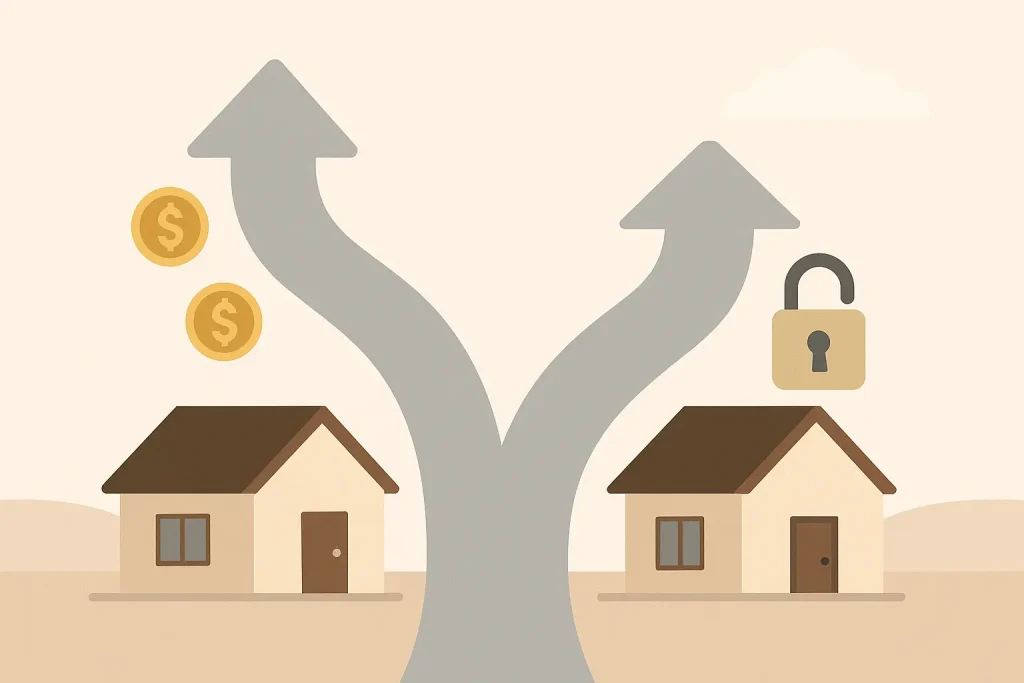
Mortgage insurance can feel like wasted money, but it can actually be used as leverage when the market is moving up.
Paying PMI can make sense if it allows you to buy sooner and start building equity while prices rise. Waiting to save a full 20 percent down payment might mean paying more for the same home later.
Once you’re in, focus on paying extra toward your principal each month to build equity faster. Check your loan balance and home value every year to see if refinancing makes sense.
PMI isn’t something to fear. It’s a short-term cost that can open the door to long-term ownership and wealth building a practical example of equity leverage in action.
From Payment to Power
Mortgage insurance is a short-term cost that comes with getting into a home sooner. It might feel unnecessary, but it’s often just part of the journey toward full ownership.
The key is to stay proactive. Keep an eye on your home’s value, track your loan balance, and know when you’ve built enough equity to drop it.
Every payment brings you closer to owning more of your home and less of your debt. When that day comes, you’ll see mortgage insurance for what it really was—just a stepping stone on your path to financial freedom.